Head of the Ahmadiyya Muslim Community Addresses the Concluding Session of the National Ijtema of Majlis Khuddam-ul-Ahmadiyya UK 2026
“Prayer offered with true devotion becomes a powerful catalyst for moral reformation. It shields believers from the worldly vices and temptations that surround us” – Hazrat Mirza Masroor Ahmad
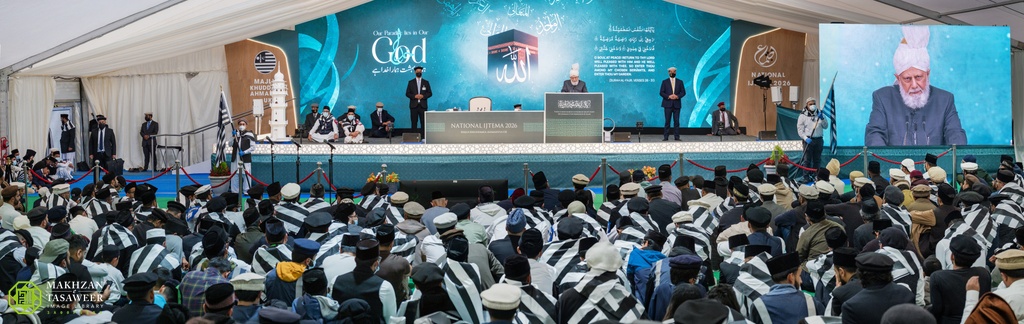
On 27 September 2026, the World Head of the Ahmadiyya Muslim Community, the Fifth Khalifa (Caliph), His Holiness Hazrat Mirza Masroor Ahmad, delivered a faith-inspiring address to conclude the National Ijtema (Annual Gathering) of Majlis Khuddam-ul-Ahmadiyya UK, the auxiliary organisation of the Ahmadiyya Muslim Community for young men and boys.
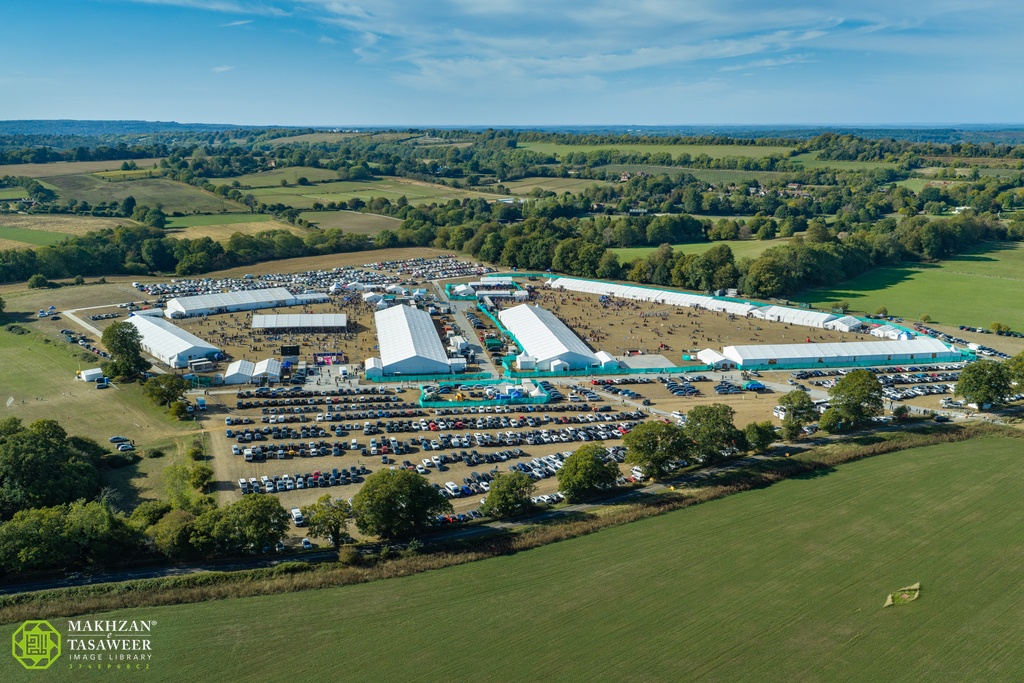
The three-day event was attended by 8,138 members of the youth organisation and served to inspire the attendees towards practising their faith and serving humanity with devotion.
At the outset of his address, His Holiness highlighted the capabilities of the young members of the Ahmadiyya Muslim Community and their potential to serve both the Community and humanity. However, His Holiness emphasised that education, professional skills and physical abilities alone are not the determining factors in the success of a “divine religious community”. His Holiness stated, “rather, it is contingent upon the Grace of Allah and its members acting with Taqwa (righteousness) and establishing a close bond with Allah the Almighty”.
Explaining how a person can attain the nearness of Allah, His Holiness said that this requires fulfilling “the rights of Allah’s worship, acting upon His commands and discharging the rights of mankind”.
Hazrat Mirza Masroor Ahmad stated:
“Certainly, a religious community cannot move forward and attain success if its members are weak in this regard.”
His Holiness then drew attention to the great blessing of having been born in the era of the Promised Messiah (peace be upon him), whose advent was foretold by Allah the Almighty and the Holy Prophet Muhammad (peace and blessings of Allah be upon him). His Holiness said that while countless pious people throughout the centuries had prayed for and searched for the Promised Messiah (peace be upon him), Ahmadi Muslims had been blessed to recognise him and pledge allegiance to him.
Addressing the attendees of the event, Hazrat Mirza Masroor Ahmad stated:
“Thus, as you navigate this world that is consumed by materialism and endless distractions, always recognise and appreciate how fortunate you are. Not only were you born in this era of the Promised Messiah (peace be upon him) but you have also been guided to accept him and to witness the grand manifestation of Allah’s Promise and the fulfilment of the great prophecy of the Holy Prophet Muhammad (peace and blessings of Allah be upon him).”
His Holiness explained that this blessing carries profound responsibility. Having taken the Bai’at (pledge of allegiance) of the Promised Messiah (peace be upon him), Ahmadi Muslims pledge to give precedence to faith over all worldly matters, fulfil the rights of Allah and mankind, strive for righteousness, obey Allah, His Messenger (peace and blessings of Allah be upon him) and the Promised Messiah (peace be upon him), and exemplify peace and compassion.
Referring to the ten Conditions of Bai’at, His Holiness said Ahmadi Muslims should regularly reflect upon them to strengthen their faith and understand their religious responsibilities, before focusing particularly on two Conditions.
His Holiness first drew attention to the Third Condition of Bai’at, which relates to the five daily prayers.
Hazrat Mirza Masroor Ahmad stated:
“When a person stands before Allah, it should be with the certainty that Allah hears all their supplications and is the possessor of all powers. He is All-Hearing (Al-Sami) and All-Knowing (Al-Aleem). He is All-Aware (Al-Khabeer) and All-Powerful (Al-Qadir). Thus, perform your prayers with complete conviction and trust in Allah and with absolute humility – rather than just repeating the words out of habit.”
Hazrat Mirza Masroor Ahmad continued:
“Furthermore, the Promised Messiah (peace be upon him) taught that we must never become hopeless or assume that Allah is not listening to our prayers. Rather, our trust in Allah must remain steadfast. At times, people ask why Allah has not accepted their prayers. Instead of showing frustration or impatience, they must remember that the acceptance of prayer is conditional. If we desire for Allah to respond to our supplications, we must first obey His commands. So, every person should ask themselves whether they are truly acting upon Allah’s commands.”
Addressing the common excuse that busy schedules and demanding workloads make it difficult to offer prayers at their prescribed times, His Holiness said that this was not a new issue. He related how people who had newly accepted Islam once sought permission from the Holy Prophet (peace and blessings of Allah be upon him) to be exempted from the prayers because they were busy during the day tending to their livestock and the nature of their work often left their clothes soiled. In response, the Holy Prophet (peace and blessings of Allah be upon him) made clear the fundamental importance of prayer and stated the following:
“Take heed! If there is no Salat, then there is nothing. Faith without worship is no faith at all.”
Following this, His Holiness emphasised that true worship extends beyond the five daily prayers.
Hazrat Mirza Masroor Ahmad stated:
“The five daily prayers are the bare minimum of what is required, otherwise a true believer should remember Allah at all times so that he may be inspired to give precedence to his faith over all worldly matters. Only then will he recognise that Allah is watching his every deed and abstain from violating His teachings and commands. Allah promises that if a person reaches this spiritual state, their Salat and remembrance of Him shall protect them from all forms of indecency and immorality.”
Hazrat Mirza Masroor Ahmad continued:
“Thus, Salat offered with true devotion becomes a powerful catalyst for moral reformation. It shields believers from the worldly vices and temptations that surround us – whether online, on television, across social media or anywhere else. Nor will such people ever think of deceiving others in their business dealings or short-change their nation by failing to pay their due taxes or to transgress the law in any way. Nor will they be minded towards any other type of sin.”
Turning specifically to the obligation of congregational prayer, His Holiness reminded the young Ahmadi Muslim men that, generally, they enjoy good health and physical strength and therefore should not use physical infirmity as an excuse to avoid attending the mosque or Salat (prayer) centre.
Hazrat Mirza Masroor Ahmad stated:
“Generally, young people enjoy good health and physical vigour and so Khuddam cannot plead physical infirmity or frailness as an excuse to avoid going to the Mosque or Salat Centre. So, offer your prayers in congregation at all possible times. If, however, you are at work and there is no one else to pray with, or some other necessity, you should still offer your prayers at the correct times. If your intention is pure, Allah can bestow upon you the same reward as those who pray in congregation, as the Holy Prophet (peace and blessings of Allah be upon him) taught that deeds are judged by intentions.”
His Holiness then reminded the members of Khuddam-ul-Ahmadiyya why they must give particular attention to their prayers in the face of the challenges of today’s world.
Hazrat Mirza Masroor Ahmad stated:
“In today’s world, wherever one turns, he is confronted with widespread immorality and vice. And so, to shield yourself from these influences, you must prioritise worshipping Allah above all else. Otherwise, the world is hurtling rapidly towards an ever deeper moral decay and those who fail to protect themselves from such corruption will incur Allah’s displeasure.”
His Holiness emphasised that believers should continuously pray that Allah Almighty does not take them from this world while they remain spiritually blind and unaware of His Grace, Mercy and Majesty. His Holiness said “we must constantly pray that whenever Allah calls us back to Him, it be at a time when our worship and devotion is of the highest order.”
Hazrat Mirza Masroor Ahmad stated:
“In short, Salat is the single most indispensable part of our faith. Therefore, from a young age, ensure the five daily prayers remain your constant and life-long companion. Never assume that you are ‘too young’, or that you have many years ahead to build your connection with Allah.”
Following this, His Holiness drew attention to the tenth and final Condition of Bai’at (pledge of allegiance), which he said was of particular importance for members of Khuddam-ul-Ahmadiyya.
The tenth Condition of Bai’at states:
“And that is that he or she shall enter into a bond of brotherhood with this humble servant of God, pledge obedience to me in everything good for the sake of God, and remain faithful to it until the day of his or her death.”
Explaining this Condition, His Holiness said that the pledge requires every Ahmadi to establish a bond of love and loyalty with the Promised Messiah (peace be upon him). It demonstrates acceptance of the Messiah and Imam Mahdi (Promised Reformer) sent by Allah Almighty according to His Promise and the prophecies of the Holy Prophet Muhammad (peace and blessings of Allah be upon him), together with a firm commitment to act upon his teachings and serve his cause.
Hazrat Mirza Masroor Ahmad stated:
“If a person is sincere in this pledge, their connection with the Community will naturally grow stronger and they will be shielded from negative thoughts and satanic influences. Their faith in the Promised Messiah (peace be upon him) and Khilafat-e-Ahmadiyya will always remain firm and resolute.”
Hazrat Mirza Masroor Ahmad continued:
“It is self-evident that a Prophet will never act or speak against Allah’s Law, nor will he ever issue a command that defies wisdom. Thereafter, Khilafat is mentioned, signifying that after the life of a Prophet, his followers must render complete obedience to the Khalifa and his appointed representatives.”
Nearing the end of the address, His Holiness reminded attendees that every step taken by a member of Khuddam-ul-Ahmadiyya should lead towards Taqwa (righteousness) and a closer connection to Allah Almighty.
Hazrat Mirza Masroor Ahmad concluded:
“At the end, I pray all of you recognise that it lies upon you to be at the forefront of bringing about a true and everlasting spiritual revolution in the world and to live your lives as faithful and devoted servants of the Promised Messiah (peace be upon him) and bring the world under the banner of the Holy Prophet (peace and blessings of Allah be upon him). May Allah enable all of you to rise to this noble challenge. Ameen.”