Hazrat Mirza Masroor Ahmad Urges Ahmadi Muslims to Continue to Seek Righteousness Beyond Ramadan in Eid-ul-Fitr Sermon
“May Allah the Almighty make this Eid blessed for all of us, both in our faith and in our worldly affairs. We should also pray for this, so that our greeting of ‘Eid Mubarak’ is not merely a phrase uttered by our tongues, but that it becomes a truly blessed Eid for everyone.” – Hazrat Mirza Masroor Ahmad
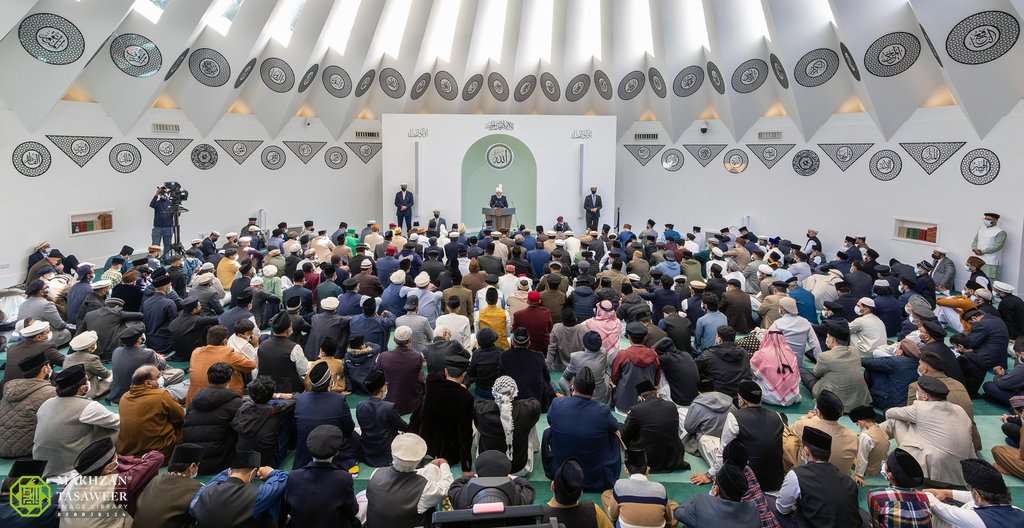
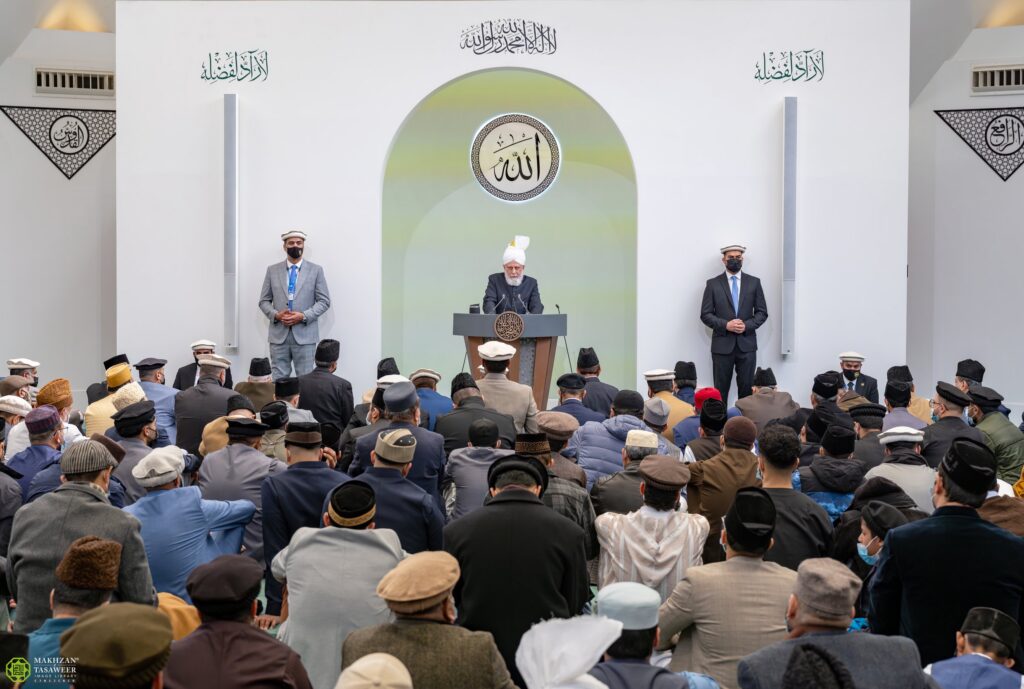
On 20 March 2026, the Worldwide Head of the Ahmadiyya Muslim Community, His Holiness Hazrat Mirza Masroor Ahmad, delivered the Eid-ul-Fitr sermon at Mubarak Mosque in Islamabad, Tilford, UK. Eid-ul-Fitr marks the conclusion of the holy month of Ramadan, during which Muslims express gratitude to Allah the Almighty for the opportunity to fast and to attain spiritual nearness to Him.
At the outset of his sermon, His Holiness emphasised that Muslims must remain mindful of the true spirit of Ramadan and the blessings it brings. He cautioned that its conclusion should not lead to a return to former habits, nor should the spiritual gains of the month be forgotten in the celebration of Eid.
Hazrat Mirza Masroor Ahmad opened his sermon and said:
“Today, having passed through the month of Ramadan, we celebrate Eid. However, this Eid should be observed as an expression of gratitude to Allah the Almighty for enabling us to benefit from Ramadan through fasting and worship. Many people were granted the opportunity to offer Tahajjud [voluntary prayers offered before dawn] prayers, while others were enabled to observe the Tarawih prayers [special prayers offered in the evening during the month of Ramadan. Likewise, many were granted the ability to regularly recite the Holy Qur’an and complete its reading. They were enabled to listen to religious discourses, for within the Community gatherings, lessons from the Holy Qur’an are also delivered. They were granted the opportunity to engage in the remembrance of Allah.”
Whilst addressing the persecution faced by Ahmadis and the restrictions placed on the expression of their faith in certain parts of the world, including Pakistan, Hazrat Mirza Masroor Ahmad stated:
“However, in countries such as Pakistan, observing Ramadan is very difficult, as we are not able to worship freely and the laws are used against us. In any case, we should pray that Allah the Almighty soon creates the means for such restrictions to be removed, so that we may also be able to fulfil the right of worship freely in Pakistan.”
Whilst outlining the true objectives of Ramadan and Eid, Hazrat Mirza Masroor Ahmad said:
“The purpose I have mentioned [of attaining nearness of Allah] is the true objective of Ramadan. If, during these days, one has not developed the inclination to attain this purpose, then for such people Eid becomes merely a festival that they celebrate: they gather for enjoyment, to wear new clothes, and amuse themselves, and thus consider their objective fulfilled. Whereas this is not the purpose of Eid at all. Rather, it is an occasion of thanksgiving, a manifestation of gratitude that Allah the Almighty granted us the ability to make sacrifices, to fulfil the rights owed to Him and the rights owed to His creation, and then commanded us to celebrate Eid. Therefore, we should express our gratitude to Allah the Almighty.”
His Holiness continued and said:
“I hope that the majority of Ahmadis have striven to benefit fully from the blessings of Ramadan, so that they may increase in righteousness and grow in guidance. They should advance in the worship of Allah the Almighty and develop a greater inclination towards virtuous deeds. For this, one must continue to seek Allah’s help, praying that He enables us to perpetually uphold the good deeds, acts of worship, and fulfilment of the rights of others that He granted us the ability to observe during Ramadan.”
Whilst reflecting on the spiritual lessons imparted during Ramadan and the need to internalise and sustain them, Hazrat Mirza Masroor Ahmad advised:
“It should not be that only Ramadan is devoted to such spiritual efforts; rather, every day of our lives should pass in fulfilling the rights of Allah’s worship, acting upon His teachings, and discharging the rights owed to His creation. Allah the Almighty has taught us Surah al-Fatihah [the opening chapter of the Holy Qur’an] and has instructed us to recite repeatedly, in every prayer and in every unit of prayer. Why is this so? It is so that we are constantly reminded that we must always strive to fulfil the rights of servitude to Allah, to worship Him as He deserves, and to act upon His commandments.”
Hazrat Mirza Masroor Ahmad stated:
“In Surah al-Fatihah, Allah the Almighty sets forth His fundamental attributes and, in doing so, teaches us to express gratitude to Him. Within this chapter, our attention is drawn to seeking the path of guidance, striving to be among those who are recipients of His favours, and seeking His protection from incurring His wrath and from falling into misguidance. Thus, Allah the Almighty directs us to remain focused on attaining these virtues, becoming worthy of His grace, and safeguarding ourselves from His displeasure and punishment. This, in essence, is our objective.”
Hazrat Mirza Masroor Ahmad said:
“Allah the Almighty further teaches us in this Surah: ‘O Allah, we worship You alone and seek to worship You alone; yet the strength and focus required to do so can only be developed through Your grace and Your help. Therefore, O Allah, grant us Your assistance.’ Through this supplication, a person’s complete reliance is directed towards Allah the Almighty, and one no longer entertains the thought — nor can such a thought arise — that these blessings and the ability to worship are attained through one’s own merit. Rather, they are purely granted by Allah’s grace.”
During his address, His Holiness cited a well-known narration of the Holy Prophet (peace and blessings of Allah be upon him), explaining that a person must first strive and make a sincere effort to draw nearer to Allah the Almighty. It is only after such effort is made that Allah the Almighty opens the doors to spiritual progress and nearness.
Hazrat Mirza Masroor Ahmad said:
“It is the decree of Allah the Almighty that the initial step must come from the servant. When a person strives to turn towards Him, then, as the Holy Prophet (peace and blessings of Allah be upon him) has stated, if a person moves a handspan towards Allah, Allah comes two handspans closer; if a servant takes one step towards Him, Allah takes two; and when a servant walks towards Him, Allah comes running towards him. Therefore, we must always bear this principle in mind: if we wish to continue benefiting from the blessings of Ramadan, we must strive for it. We must consistently take steps towards Allah, move towards Him, and seek to come under His shelter through earnest effort and heartfelt supplication.”
Towards the conclusion of his address, His Holiness reflected on the prevailing state of the world, marked by widespread cruelty and injustice, and offered prayers for peace across Muslim countries and throughout the entire world.
Hazrat Mirza Masroor Ahmad said:
“We must always remember the condition of Muslims today, particularly in those countries where there is unrest, disorder, and the devastation of war. In such places, people may still offer the Eid prayer in fulfilment of their obligation, yet their homes have been destroyed and left desolate due to unjust attacks. Some children have been deprived of their parents, while some parents have lost their children, and a state of fear prevails over them.
May Allah the Almighty grant them ease and enable them to become His true servants, turning solely towards Him and not relying on worldly powers. Indeed, it is reliance upon such worldly ‘gods’ that has led to the dire condition we witness in many of these countries today. May they attain true freedom in this world and be enabled to fulfil the rights of worshipping Allah. May Allah the Almighty protect them from all forms of oppression.”
Hazrat Mirza Masroor Ahmad continued:
“May Allah the Almighty also safeguard the Community established across the world. As the Promised Messiah (peace be upon him) has taught, we must pray not only for ourselves but also for our brothers and for all humanity… when we witness the world turning towards Allah the Almighty and gathering under the banner of the Holy Prophet (peace and blessings of Allah be upon him), that will be our true joy.
Our real Eid will be fulfilled when we see the mission of the Promised Messiah (peace be upon him) accomplished. May Allah the Almighty grant us such an Eid, wherein we witness the end of disorder and strife in the world, the banner of the Holy Prophet (peace and blessings of Allah be upon him) raised aloft in the world, and the Oneness of Allah firmly established. May Allah grant us the ability to achieve this.”
Concluding his address, Hazrat Mirza Masroor Ahmad prayed:
“May Allah the Almighty make this Eid blessed for all of us, both in our faith and in our worldly affairs. We should also pray for this, so that our greeting of ‘Eid Mubarak’ is not merely a phrase uttered by our tongues, but that it becomes a truly blessed Eid for everyone.”
Later in the day, His Holiness delivered a short Friday Sermon in which His Holiness emphasised the importance of maintaining a high standard of worship, advising that any pursuit of worldly matters should be undertaken only insofar as it serves to strengthen one’s faith.
Hazrat Mirza Masroor Ahmad said:
“The Promised Messiah (peace be upon him) has said that the broader a believer’s engagement with the world, the greater the means for attaining higher spiritual ranks; provided that their fundamental objective remains faith. In other words, all worldly relationships and pursuits should ultimately serve the cause of religion; this is the hallmark of a true believer. The world and its wealth and status are to be servants of faith, not ends in themselves.”
His Holiness continued:
“Thus, the essential principle is that the world should never become an objective in its own right. Rather, even in the pursuit of worldly gains, the primary aim must be the betterment of one’s faith. If one earns in this world, it should be with the intention of strengthening one’s religion and serving its cause. Worldly earnings should not be sought through wrongful means that ruin both one’s present life and the Hereafter; instead, they should be pursued to enrich one’s faith, refine one’s spiritual state, and secure one’s ultimate success in the life to come.”
Concluding the sermon, Hazrat Mirza Masroor Ahmad prayed:
“May Allah grant us the ability to improve our deeds and enable us to pray with sincerity in this regard. May He grant us the true ability to attain these virtues, enable us to offer the best of prayers, and accept them.”