Waqf-e-Nau From France Travel to Islamabad for an Audience With His Holiness, Hazrat Mirza Masroor Ahmad
“If you constantly remind yourself of your pledge and remain committed to fulfilling it, remembering that you have made a covenant [with Allah] which you must honour, then there is no question of losing motivation.” – Hazrat Mirza Masroor Ahmad
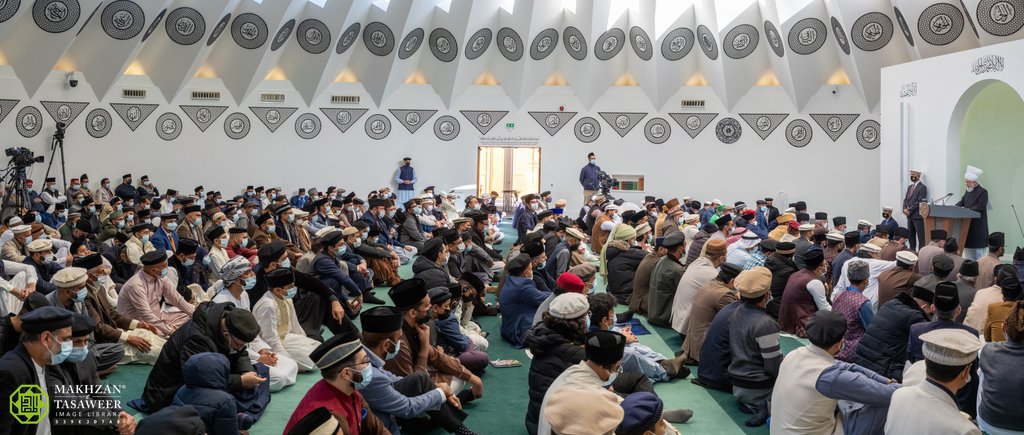
On 15 February 2026, the World Head of the Ahmadiyya Muslim Community, the Fifth Khalifa (Caliph), His Holiness, Hazrat Mirza Masroor Ahmad held a meeting with male members of the Waqf-e-Nau scheme from France.
The Waqf-e-Nau scheme is an initiative of the Ahmadiyya Muslim Community started by His Holiness, Hazrat Mirza Tahir Ahmad – the fourth Caliph of the Ahmadiyya Muslim Community. It is a scheme in which parents dedicate their unborn children to the service of faith. As they grow older, these individuals who wish to remain part of the scheme voluntarily choose to renew their pledge and are guided to shape their lives around service to the Community and society.
During the meeting, members had the opportunity to introduce themselves and also ask His Holiness questions on a range of religious and contemporary issues faced by the youth today.
One attendee asked His Holiness how we should instil the qualities of faithfulness and sincerity within children who are part of the Waqf-e-Nau scheme.
Hazrat Mirza Masroor Ahmad said:
“Tell them clearly that they are Waqf-e-Nau and that they must fulfil their pledge. Otherwise, they should leave the Waqf-e-Nau scheme. If you have voluntarily devoted yourselves, then do so with loyalty. If not… it becomes hypocrisy, not faithfulness or sincerity.
True sincerity is this: we have pledged that we will give priority to faith over worldly matters. Therefore, Waqf-e-Nau members must bind themselves to this pledge more than anyone else, that we will place religion above the world.”
His Holiness continued:
“Those who work with sincerity and loyalty will earn the pleasure of Allah the Almighty, and this also reflects a person’s high moral character.”
One attendee asked His Holiness about the origins of creation, specifically enquiring when Allah the Almighty began creating the universe and whether the Big Bang marked the beginning of all creation, or if creation had already commenced prior to it.
Hazrat Mirza Masroor Ahmad said:
“Allah the Almighty states in the Holy Qur’an, in Surah al-Anbiya, that everything was joined together and then He split it apart. That was the Big Bang, and from it this entire universe came into existence. There are many such universes. This world did not exist before that. Allah the Almighty also says that He will one day roll it up again, just as pages are folded… So, we only know as much as Allah has informed us. Beyond this, He has not revealed more.”
One attendee asked how a person can recognise whether they are making genuine spiritual progress in the sight of Allah the Almighty.
In response, Hazrat Mirza Masroor Ahmad explained that spiritual progress is not always constant and that fluctuations in one’s spiritual state are part of human nature.
Thereafter, Hazrat Mirza Masroor Ahmad said:
“Nowadays, I am narrating how the Holy Prophet (peace and blessings of Allah be upon him), and the Promised Messiah (peace be upon him) used to pray, and how righteous people pray. [Therefore], when you feel deep emotion and humility, then it means that Allah the Almighty is pleased with you and that it is a time when your prayers are being accepted. At such times, you should pray earnestly.”
Hazrat Mirza Masroor Ahmad continued:
“When your heart feels constricted and spiritually empty, even then you must strive to continue offering Tahajjud and regular prayers. In that state, ask Allah that, ‘O Allah, these days my heart feels closed and is not opening towards spirituality. Grant me Your help.’ Seek assistance from Allah and repeatedly recite the prayer, Ihdinas-siratal-mustaqeem (Guide us on the straight path).”
One attendee explained that many non-Ahmadi Muslims claim that those who do not adhere to the practices of Islam are destined for hell. The attendee asked His Holiness to expound upon the truth of this matter.
“Allah has not written this in the Qur’an, nor is it written in the Hadith. Allah has stated clearly that whoever does good deeds, He will reward them. Yes, those who reject the truth and persist in opposition, who oppose the prophets, oppose their communities, and commit injustice, will be punished by Allah. However, if they have done any good, Allah will also reward them for it. Allah says that when you do a good deed, He multiplies its reward many times over, and when you commit a sin, you are punished only in proportion to that sin. If a believer acts in this way, then his sins are forgiven and he will enter Paradise. But who is to enter Paradise and who is to enter Hell is Allah’s matter. Allah is Most Forgiving.”
His Holiness then gave the example of those so-called Muslims who are engaged in violence, terrorism or extremism.
His Holiness said:
“Some [so-called] Muslims are involved in killing, terrorism, and oppression… These people will not enter Paradise. They are destined for Hell, as far as is apparent, because Allah says that whoever commits injustice will be punished.”
His Holiness referred to a well-known incident to highlight the danger of arrogance and judging others. He explained that a person who considered himself righteous condemned another for his sins and assumed he was destined for Paradise. However, because of his pride and lack of humility, Allah the Almighty condemned him as Allah is the One and True Judge, while showing mercy to the one he had looked down upon.
Hazrat Mirza Masroor Ahmad said:
“Therefore, when non-Ahmadis say such things, our duty is to ensure our own conduct right. We must perform good deeds. We must fulfil the rights of Allah by praying and worshipping Him. Fulfil the rights of people by showing good morals, caring for the poor, respecting elders and youngsters, and treating everyone with dignity. There are two sets of rights: the rights of Allah and the rights of people. We must fulfil both.”
His Holiness continued:
“The Holy Prophet (peace and blessings of Allah be upon him) was asked why he prayed so much when Allah the Almighty had already forgiven him. He replied that Allah is Self-Sufficient, and that he too would enter Paradise only through Allah’s grace, not through his own deeds. If this is the status of the Holy Prophet (peace and blessings of Allah be upon him), then who are these non-Ahmadis to issue certificates about who will go to Paradise and who will go to Hell? They are deceivers.”
His Holiness continued:
“Before prophethood, the Holy Prophet (peace and blessings of Allah be upon him) was part of a committee called Hilf al-Fudul, formed to help the poor. After prophethood, he said that if those same non-Muslims were to invite him again for such good work, he would join them, despite his great status as a Prophet of Allah. This shows that Allah rewards good deeds. He will give them their reward, and He will also punish wrongdoing.
Moreover, the Holy Prophet (peace be upon him) also said that a time will come when Hell will become empty and all will enter Paradise. So those who arrogantly say, ‘You will go to Hell and I will go to Paradise,’ do not know their own fate. We should seek forgiveness. Remain humble, continue repenting, and pray that Allah grants us a good end. And remember, whoever does good, Allah rewards them.”
One attendee asked how a person serving the Community should respond if they experience a temporary loss of motivation in their duties to their faith.
In response, Hazrat Mirza Masroor Ahmad explained:
“In the Holy Qur’an, Allah the Almighty has mentioned the example of Prophet Abraham (peace be upon him) and said: ‘And of Abraham, who fulfilled his covenant.’ This means that he remained faithful to his pledge.
If you constantly remind yourself of your pledge and remain committed to fulfilling it, remembering that you have made a covenant [with Allah] which you must honour, then there is no question of losing motivation.
Yes, at times a person may feel lazy. When this happens, one should turn again to Istighfar (seeking forgiveness), recite ‘Ihdinas-Siratal-Mustaqeem’ (Guide us on the straight path), pray to Allah, and then begin serving again with renewed determination.”