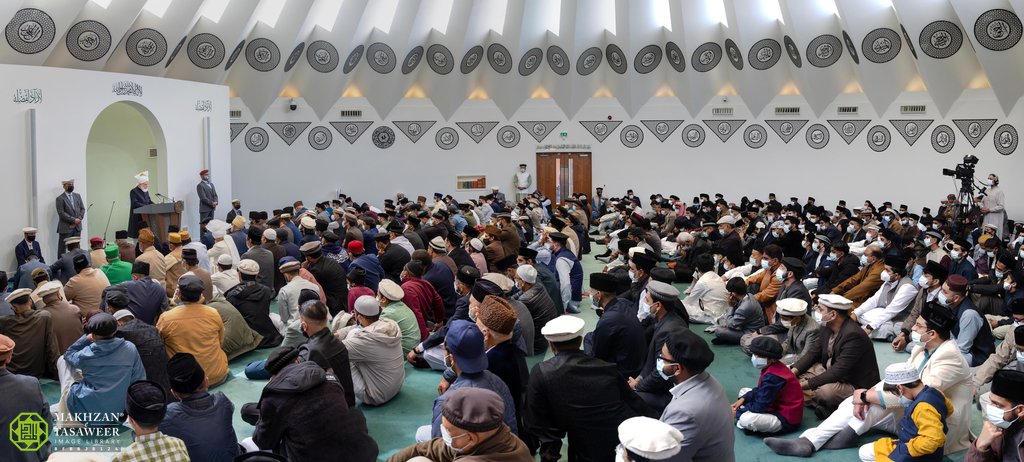
Virginian Khuddam Meet With His Holiness, Hazrat Mirza Masroor Ahmad, World Head of the Ahmadiyya Muslim Community
“The Holy Prophet (peace and blessings be upon him) should be remembered throughout the entire year, his noble example should be presented continuously, and efforts should be made to act upon it. This is the true purpose of commemorating him.” – Hazrat Mirza Masroor Ahmad
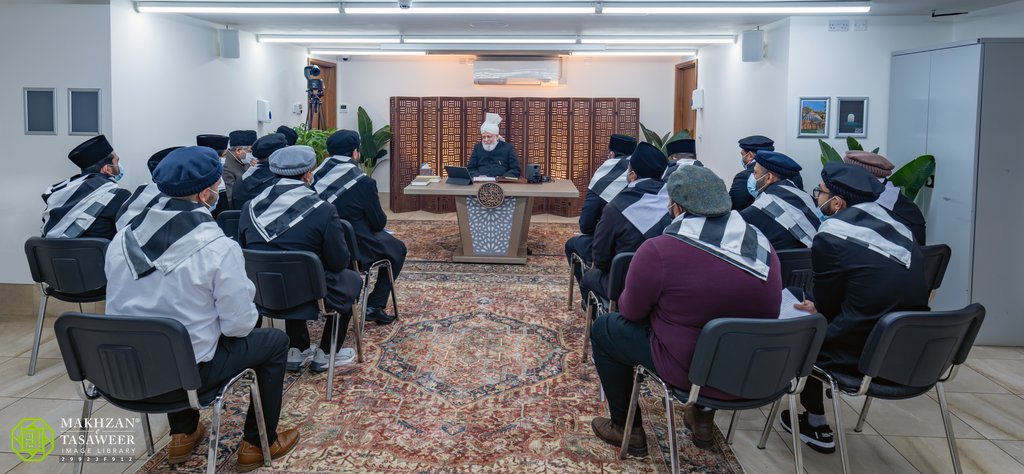
On 6 December 2025, the Worldwide Head of the Ahmadiyya Muslim Community, His Holiness Hazrat Mirza Masroor Ahmad, the Fifth Khalifa (Caliph), granted an audience to a delegation from the Virginia Region of Majlis Khuddamul Ahmadiyya USA. Majlis Khuddamul Ahmadiyya is an auxiliary body dedicated to guiding the moral and spiritual development of male youth.
During the audience, each delegate had the opportunity to introduce themselves. Afterwards, members sought His Holiness’ guidance on a variety of contemporary challenges facing young people.
An attendee asked His Holiness how one should respond when confronted with cruelty or injustice within their own family, and how such strained relationships can be improved.
In reply, Hazrat Mirza Masroor Ahmad stated:
“Pray for them (one’s relatives), and pray that Allah grants them wisdom and understanding. Also pray for yourself, that Allah gives you the strength to endure. Further, go to them directly and ask what reasons they have for causing you pain, so that those issues can be amicably resolved. You should sit together with mutual understanding.
“Allah says in the Holy Qur’an that believers should show mercy to one another. The Holy Prophet (peace and blessings of Allah be upon him) said that believers are brothers to one another, so you should live together in this spirit of harmony… As for the causes of quarrels, whatever reasons you are aware of, strive to remove them. Do not become angry; make reconciliation a habit.”
Another attendee asked how an Ahmadi Muslim should respond to bullying or discrimination for being a Muslim at school while remaining true to Islamic teachings.
In response, His Holiness said:
“You should say, ‘I follow a religion and I believe it to be true. If you are defaming Islamic teachings because of someone’s actions or deeds, that is not the fault of the teaching itself. It is the fault of those who act wrongly. Islam teaches love and compassion.’ So, explain to them what Islam actually says…”
Hazrat Mirza Masroor Ahmad continued:
“If despite this they continue (to discriminate), then say, ‘Your deeds are your responsibility, and my deeds are mine. I will not say anything to you, because my teaching is to speak gently.’ After hearing this, some of them will feel ashamed – those who have any sense of shame – and those who are very stubborn, ignore them.”
Another attendee asked His Holiness if it is permissible for members of the Ahmadiyya Community to celebrate Eid Miladun Nabi, the birth of the Holy Prophet of Islam (peace and blessings of Allah be upon him).
In reply, Hazrat Mirza Masroor Ahmad said:
“When vehement opposition against Islam increased, Hazrat Khalifatul Masih II initiated the idea that we should hold a gathering in remembrance of the Holy Prophet (peace and blessings of Allah be upon him), in which his noble life would be recounted. After that, other Muslims adopted it and began to celebrate it specifically as the birthday of the Holy Prophet (peace and blessings of Allah be upon him).”
However, His Holiness went on to explain that this festival was never observed by the Holy Prophet (peace and blessings of Allah be upon him), nor by his successors or companions. Rather, it emerged centuries after his passing and therefore holds no authentic basis in Islamic tradition.
Hazrat Mirza Masroor Ahmad continued:
“Originally, it was the Ahmadiyya Muslim Community that began holding such gatherings [in remembrance of the Holy Prophet (sa)], but Hazrat Musleh Maud [the Second Caliph of the Ahmadiyya Muslim Community] said that it should not be confined to one day. He instructed that the life of the Holy Prophet (peace and blessings be upon him) should be remembered throughout the entire year, that his noble example should be presented continuously, and that efforts should be made to act upon it. This is the true purpose of commemorating him. Simply holding a gathering, delivering speeches, lighting lamps, chanting slogans, and then insulting others brings no benefit.”
His Holiness further said:
“In Pakistan, non-Ahmadis hold gatherings, but instead of recounting the life of the Holy Prophet (peace and blessings of Allah be upon him), they curse the Promised Messiah (peace be upon him) and Ahmadis. So what benefit can such celebrations have?
As for us, we must not celebrate Eid Miladun Nabi as a festival, but rather present the life and character of the Holy Prophet (peace and blessings of Allah be upon him) to people throughout the entire year. That is our teaching, and that is what we do. There is no need for a special day – the need is for the whole year.”
Another attendee asked how Ahmadi Muslims today can effectively convey Islam’s true message in a world which is becoming more and more polarised.
His Holiness responded by emphasising that the real teachings of Islam, centred on love, harmony and peace, must be communicated to the wider world with far greater effort. He reminded the delegation that many people still do not know what Ahmadiyyat is, nor do they understand Islam’s core principles, such as caring for the poor and orphans, resolving conflicts, upholding justice and serving humanity.
His Holiness highlighted the importance of actively promoting Islam’s true teachings by drawing upon his public addresses – including his address at the Humanity First Conference, the inauguration of the Baitur Raheem Mosque in Cardiff, and those compiled in Pathway to Peace. He emphasised the need to counter anti-Islamic narratives by showing that loyal citizenship and diligent service to one’s country are fundamental Islamic values. His Holiness noted that this is among the greatest challenges facing the Community today.
Another attendee asked His Holiness how we can tackle phone and social media addiction.
Hazrat Mirza Masroor Ahmad responded:
“I have been saying for a long time that children’s screen time – whether on phones, tablets or similar devices – should be kept to an absolute minimum. It affects their eyesight and it affects their mental development. Unfortunately, nowadays schools themselves begin issuing iPads to children after a certain age and instruct them to complete their work and homework on these devices. It has reached a stage now where people around the world are beginning to realise the (harmful) consequences.”
His Holiness continued:
“Recently, a law was passed in Australia banning children from using social media. This has caused significant debate. Denmark is now considering similar measures, other countries are doing the same, and even here discussions have begun. They themselves have realised the harm… So, explain to your children that excessive screentime damages their eyesight and lessens their attention spans. Even if they wish to watch a programme on the television or iPad, their screen time should not exceed one hour. Explain it in such a way that they understand it is for their own good, and show them that the world itself is now acknowledging the harm.”
Continuing on the negative effects of social media, Hazrat Mirza Masroor Ahmad said:
“Social media – you know that it is harmful. We all know it causes addiction. We know it damages our family relationships, our social relationships, and even affects our work and businesses. It is causing harm, and you are aware of it. When you know all this and still continue using it in the same way, what else can it be called except foolishness? The only solution is to have firm determination that you will not fall into these harmful practices. Allah the Almighty has commanded that we avoid vain and useless habits – and all of this falls under such vain pursuits…”
Guiding Ahmadi Muslims on how to avoid or limit use of social media and use of devices, His Holiness said:
“The way to avoid it is to recite istighfar, and to develop a strong resolve that you will not engage in such things. Tell yourself firmly: ‘I will not do this. If I watch one programme, I will stop at one; I will not go further than this.’ Only then can this addiction be removed… A believer should possess strong willpower, and should pray that Allah protects them from such vain pursuits. And when you set the right example, you will be able to guide your children…”
His Holiness further said:
“I have also mentioned before that such habits are contrary to basic manners. If people are sitting together and two are engaged in conversation while a third or fourth person is absorbed in their phone, this is not good etiquette. Explain to children that when you are sitting together, you should not engage in something others cannot understand. A gathering should involve matters of common interest. But if everyone is on their phone, where will the common interest be?”
Towards the end of the sitting, an attendee sought His Holiness’ guidance on how to strengthen and deepen one’s faith.
Hazrat Mirza Masroor Ahmad responded:
“Pray to Allah that He strengthens your faith. One must seek help from Allah for this. In Surah al-Fatihah we recite ‘Guide us on the right path’ – pray this again and again. When you recite it sincerely, Allah will show you the true path…Then you must safeguard the five daily prayers. Guarding your prayers is essential. Read the Holy Qur’an and strive to understand its meaning so that you may truly know what faith is. Otherwise, merely calling yourself a Muslim or an Ahmadi means nothing if you do not know what Islamic teachings are. Similarly, you should also read the literature of the Community. If you do not know Urdu, then read the books of the Promised Messiah (peace be upon him) in English, especially the different topics cited under ‘the Essence of Islam.’ Through this, your faith will grow and increase. When you acquire religious knowledge, your faith strengthens and along with that, continue to pray.”