Ahmadi Youth from USA’s South East Region Have Honour of Meeting His Holiness, Hazrat Mirza Masroor Ahmad
“You are an Ahmadi – an Ahmadi Muslim should be a perfect Muslim.” – Hazrat Mirza Masroor Ahmad
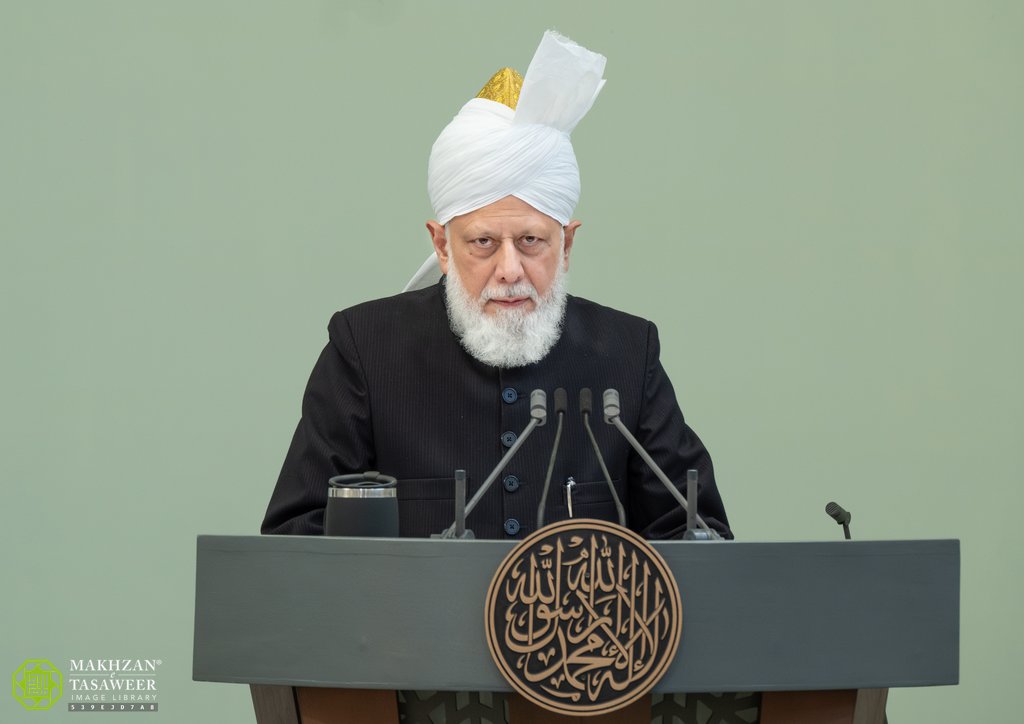
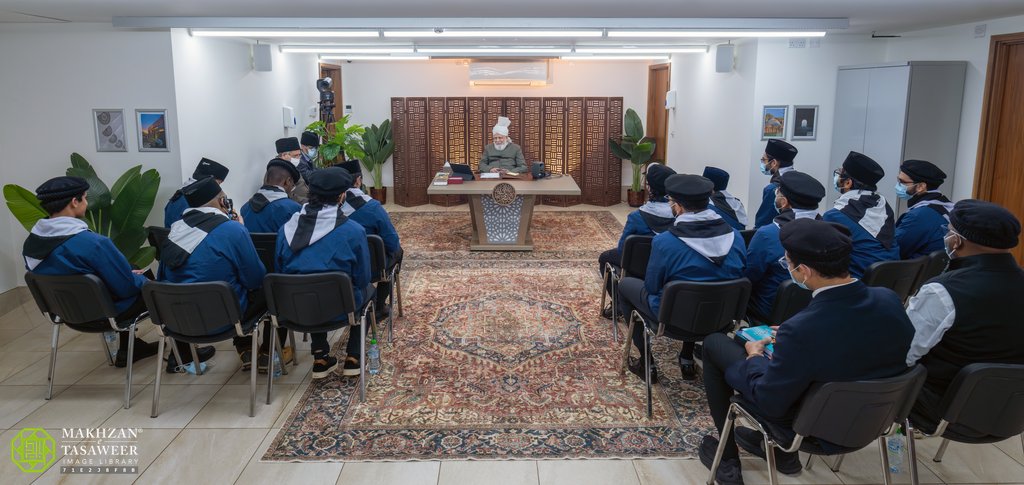
On 29 November 2025, the Worldwide Head of the Ahmadiyya Muslim Community, His Holiness Hazrat Mirza Masroor Ahmad, the Fifth Khalifa (Caliph), met with a delegation from the South East Region of Majlis Khuddamul Ahmadiyya USA.
Majlis Khuddamul Ahmadiyya (the Ahmadiyya Muslim Youth Association) is an auxiliary body of the Community committed to nurturing the moral and spiritual development of male youth between the ages of fifteen and forty.
During the meeting, delegates were given the opportunity to greet His Holiness individually and introduce themselves. After the introductions, members sought His Holiness’ counsel on a range of issues facing young people today.
A young attendee asked His Holiness what responsibilities he now held as he had just turned fifteen and had now formally joined the Ahmadiyya Muslim Youth Association (Khuddamul Ahmadiyya). His Holiness explained that moving from being a tifl (a child in the Atfalul Ahmadiyya programme, ages 7-15) to becoming a khadim (a member of the youth association, ages 15-40) required continuing the good habits formed in childhood and developing them further.
His Holiness emphasised that the foremost duty of every khadim is to maintain the five daily prayers and to strive to offer them punctually, and where possible, in congregation. He explained that Allah has promised protection from wrongdoing for those who are regular and sincere in their prayers. Alongside this, he advised the daily recitation of the Holy Qur’an.
His Holiness also advised to safeguard from harmful influences, such as inappropriate programmes or content on social media and elsewhere.
His Holiness further explained that as boys reach the age of entering Khuddamul Ahmadiyya, some begin to assume they are mature and consider themselves more aware of contemporary issues than their parents or elders. His Holiness said that this attitude should be avoided and a young khadim should strive to root himself in the teachings of the Holy Qur’an.
Hazrat Mirza Masroor Ahmad further added that whether or not one belongs to the Waqf-e-Nau scheme, the fundamental expectation remains the same.
His Holiness said:
“It does not matter [if you are a Waqf-e-Nau], you are an Ahmadi – an Ahmadi Muslim should be a perfect Muslim.”
Another attendee asked how young people can motivate themselves to strive for spiritual progress and develop a closer relationship with Allah the Almighty. Before responding, His Holiness first asked the attendee whether he felt motivated in other areas of life, such as work or study. When the attendee replied that he does, His Holiness asked what drives that motivation. The attendee answered that he wishes to secure a good future.
Thereupon, His Holiness said:
“If you love Allah, then you should have the motivation to try and gain His closeness. For that, Allah says you must struggle hard to obey His commandments. The basic thing is you must pray fervently in your five daily prayers that Allah guides you on the right path and plants a desire in your heart to increase your motivation towards achieving the love of Allah Almighty. Then, God-willing, He will guide you to the right path.
To become near to Allah, you must work hard as you work hard to achieve your worldly targets, like your studies or other pursuits. Allah says in the Holy Qur’an that you must strive in order to get close to Him, and if you work hard, He will show you the right path. This is the only way. Pray to Allah the Almighty in your five daily prayers – never leave your prayers. If you are obeying Allah’s commandments, Allah will guide you.”
Another attendee asked His Holiness how Ahmadis can ensure that the focus of the success of their careers is to win the pleasure of Allah, and to safeguard oneself from being greedy with their monetary gains.
Hazrat Mirza Masroor Ahmad stated:
“If you are following Allah’s commandments, and you are spending your money not only on yourself but on the poor, on orphans, on needy people, that means you are trying to achieve the pleasure of Allah the Almighty with your money, and Allah the Almighty will bless that money manifold. It will also prevent your heart from becoming greedy because you will be spending on other people as well. You will be feeling the pain of others, and Allah likes this.
If you are doing charity work and sacrificing for the sake of the Community after having met your own expenses – then Allah will like it and bless your money manifold and prevent you from becoming greedy.”
An attendee then asked His Holiness which surah [chapter of the Holy Qur’an] is the best to recite when seeking the guidance of Allah the Almighty.
In response, His Holiness stated:
“Surah Al-Fatihah is the best. You repeatedly say ‘Ihdinas-siratal-mustaqim – O Allah Almighty! Guide me to the right path.’ You should repeatedly say it when you are reciting your prayers. Surah Al-Fatihah contains all the important aspects for your moral upbringing and training. If you read Surah Al-Fatihah and its meaning, then you will know how important this Surah is to guide you to the right path. Ponder over it properly and then you will understand the teachings of Islam.”
An attendee asked His Holiness how the Community should respond to people who use harmful and abusive language against Islam and in reference towards the Holy Prophet (peace and blessings of Allah be upon him). The attendee also shared that there are videos being circulated online in which Muslims are being mocked and abused for praying in public.
Hazrat Mirza Masroor Ahmad said:
“When they are using abusive language, we cannot compete with them… so you must ignore it.”
In terms of offering one’s prayers in a public place, His Holiness said:
“You should go to the mosque or offer your prayers in houses. If you are bound and short of time to pray on time, then you should try to find a corner and pray there, and if you are in a group then you should go to an isolated place and offer your prayers there. It should not be that you spread your prayer mats and start offering your prayers on the footpaths or roads – that is not advisable. You are breaking the rules and regulations of that society or country, and even then, you are disturbing the convenience of the people there. You are destroying their peace. Why should you offer your prayer in public places?”
His Holiness then explained how, through the behaviour and excellent morals displayed by true Ahmadi Muslims, we can overcome this issue and educate the people. Hazrat Mirza Masroor Ahmad said:
“Be firm in your faith and be determined that you have to offer your five daily prayers on time. Do not bother about what people say. Try to learn more about your religion: what is Islam, what are the teachings of Islam, what is the practice and Sunnah of the Holy Prophet, and why we Ahmadis claim that we are Ahmadi Muslims. The claim alone is not enough until and unless we practise the true teachings of Islam.
If we are portraying good behaviour and conveying the true message of Islam to the people, and practise what we say, then people will obviously ask you why you are different from other Muslims, and they will try to learn more about Islam. In this way, you will open more doors of preaching.
People are ignorant about Islam… So, tell the people that the Islam practiced by these people [extremists] is not the true teaching. The true teachings [of Islam] are of peace, love, harmony, and to respect each other. That is what we pray, practise, and what we convey. So, it is a big challenge. This is why I say that you should try to spread the true message of Islam through pamphlets and through your own behaviour – this is how you can solve this issue.”