Muslim Youth from Sweden Have Honour of Meeting His Holiness, Hazrat Mirza Masroor Ahmad
“[The Holy Prophet] displayed great humility – showing affection towards children, kindness towards women, and compassion for the poor. Yet when the honour of Islam was challenged, he neither feared Abu Jahl nor anyone else. This is the distinction between humility and dignity.” – Hazrat Mirza Masroor Ahmad
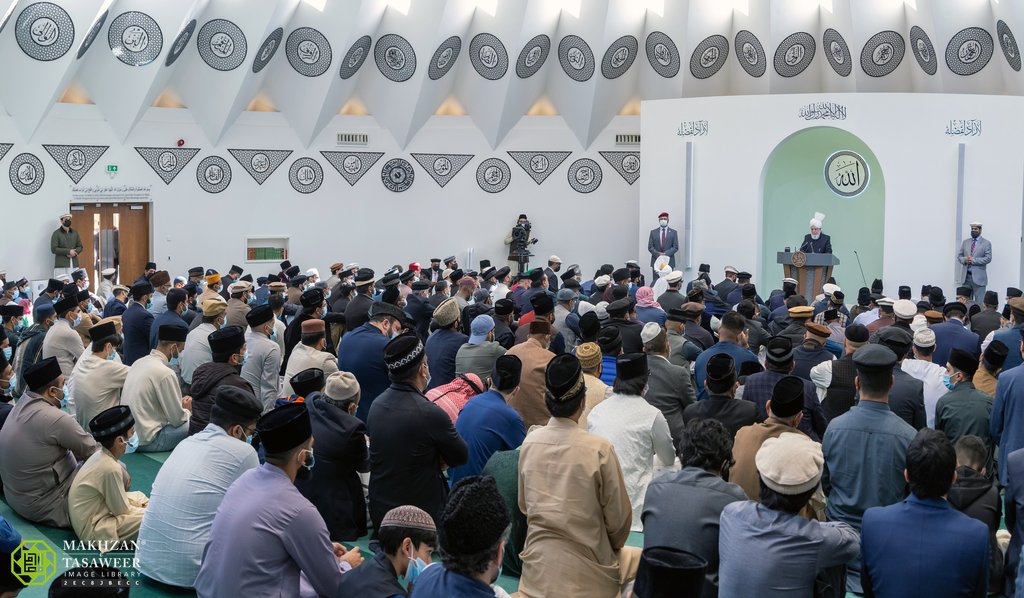
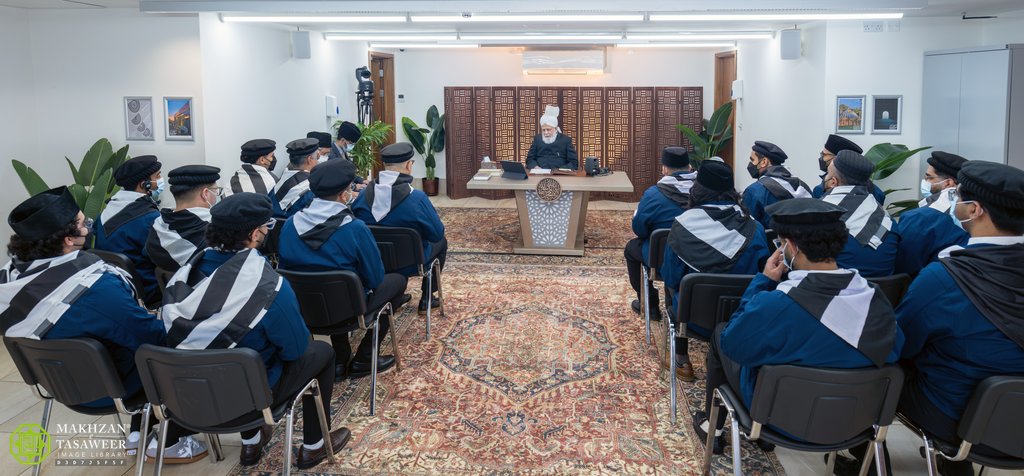
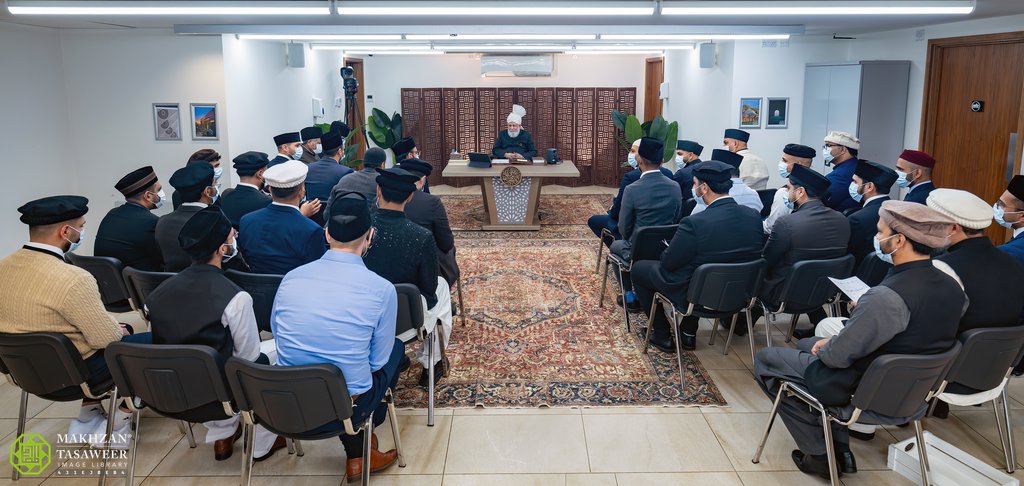
On 9 November 2025, the Worldwide Head of the Ahmadiyya Muslim Community, His Holiness Hazrat Mirza Masroor Ahmad, the Fifth Khalifa (Caliph), granted an audience to a delegation of members from Majlis Khuddam-ul-Ahmadiyya Sweden (the Ahmadiyya Muslim Youth Association), representing the regions of Gothenburg, Malmö, and Stockholm.
During the meeting, each member had the opportunity to personally introduce themselves to His Holiness. The delegation was then blessed to receive his guidance and direction on a wide range of spiritual and practical matters relevant to their personal lives and service to their faith.
One attendee asked His Holiness how parents can balance their professional responsibilities while ensuring that their work does not compromise the moral and spiritual upbringing of their children. The attendee also sought guidance on how families can manage their household expenses and curb worldly desires.
Hazrat Mirza Masroor Ahmad stated:
“If there is no one to supervise the children [when they return home after school], they will go out to play and it is possible that they may fall into bad company. Therefore, it is better that even if both parents must work, they should organise their schedules in such a way that when the children return from school, at least one of them is available to give them time and attention…
“If worldly desires continue to grow, then there is no limit to them – they will only keep increasing. A Hadith states that when it comes to worldly matters such as wealth or status, one should look to those who have less than oneself, so that gratitude may arise in the heart and one may thank Allah for granting a better condition. However, in matters of faith and spirituality, one should look toward those who are higher and more advanced, so that the desire may be born to progress spiritually and to develop a special relationship with Allah the Almighty. If this outlook is maintained, then worldly desires remain under control.”
One attendee asked His Holiness why the Holy Qur’an at times employs metaphorical language and how such verses should be understood in their proper context.
“Allah the Almighty has stated in the Holy Qur’an that some commandments are clear while others have deeper or allegorical meanings. Therefore, one should act upon the clear and manifest commandments, whereas those that have multiple layers of meaning and interpretation should be understood through scholarly commentary and contemplation.
The clear and unambiguous injunctions of the Shariah are straightforward: establish prayer, observe fasting, display good morals, care for orphans and the poor, give in charity, obey the law, and show obedience in matters of faith. These are all clear commands. If you act upon these, you need not worry about the metaphorical verses. Scholars and commentators reflect upon such verses, and you may seek guidance from them regarding their meanings.
There is a narration in which a man came to the Holy Prophet (peace and blessings of Allah be upon him) and asked what commandments he must follow. The Holy Prophet enumerated all the fundamental teachings of Islam – the obligations of prayer, fasting, Zakat, and Hajj – and then mentioned additional voluntary acts of worship. The man said, ‘By God, I shall fulfil only the obligatory acts, nothing more.’ Upon hearing this, the Holy Prophet said to his companions that if he fulfils these obligations sincerely and faithfully, he will enter Paradise.
So, do not concern yourselves unnecessarily with why certain verses are metaphorical or how they should be interpreted. These are intellectual matters. As your knowledge and understanding grow, so too will your comprehension of such verses. Focus on fulfilling your obligations – performing your prayers properly, fasting with sincerity, giving charity, caring for the poor and relatives, and fulfilling the rights of your spouses and families, as Allah has clearly commanded.
Ultimately, the fundamental matters are those clear injunctions that Allah has commanded. If you act upon them, Allah says He will forgive you. Allah has not conditioned salvation upon understanding the allegorical or metaphorical verses. He simply commands: recite the Qur’an, believe in Allah and in the unseen, and that is sufficient for you.”
One attendee asked His Holiness about the distinction between humility and self-respect, and how to maintain a balance between the two, particularly in professional or public settings, while ensuring that one’s conduct does not harm the reputation of the Community.
Hazrat Mirza Masroor Ahmad stated:
“Dignity is one thing, and humility is another. To boast about oneself in every matter, or to speak with arrogance, is something Allah has forbidden. However, Allah has not prohibited maintaining one’s dignity. When you uphold your dignity, people respect you. Some individuals are extremely humble, and people respect them precisely because of that humility – it leaves no negative impression; rather, it becomes their strength.
When a person behaves with humility and meets others with kindness, does that mean they have sacrificed their self-respect, honour, or dignity? Certainly not.
Humility is a virtue. It was for this very reason that Allah said to the Promised Messiah (peace be upon him) that his humble ways had pleased Him. Where there was room for argument, the Promised Messiah (peace be upon him) would, for the sake of Allah, withdraw rather than quarrel – and Allah loved this quality in him.
The Promised Messiah’s humility was beloved to Allah, yet did that humility mean he lacked self-respect or begged before people? Not at all. When the occasion demanded, he stood firm – he answered the Aryas, the Christians, and the atheists, and when the honour of Islam was at stake, he spoke openly and fearlessly. These examples are well-documented in his books and writings.
Similarly, the Holy Prophet Muhammad (peace and blessings of Allah be upon him) embodied this balance perfectly. At times, he displayed great humility – showing affection towards children, kindness towards women, and compassion for the poor. Yet when the honour of Islam was challenged, he neither feared Abu Jahl nor anyone else. This is the distinction between humility and dignity.”