Hazrat Mirza Masroor Ahmad Cites Examples of Honesty and Loyalty of Early Believers in Friday Sermon
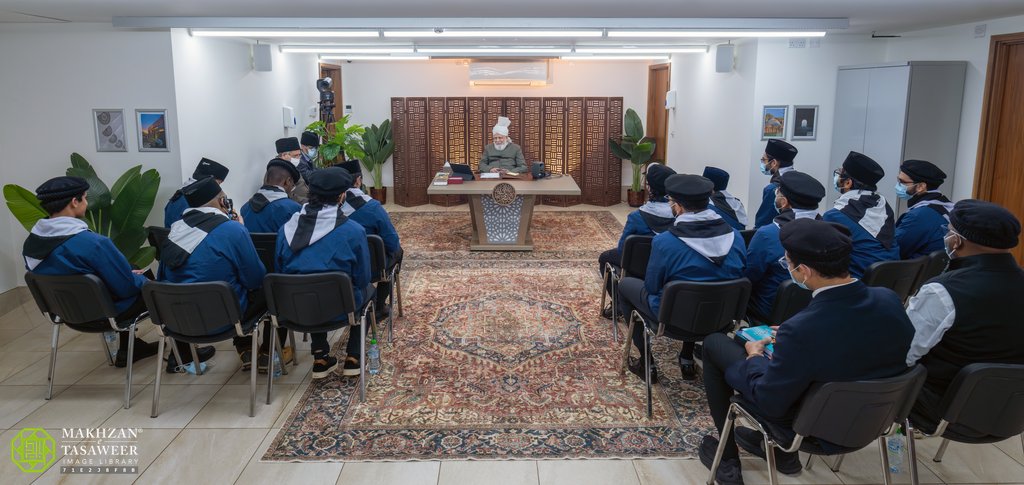
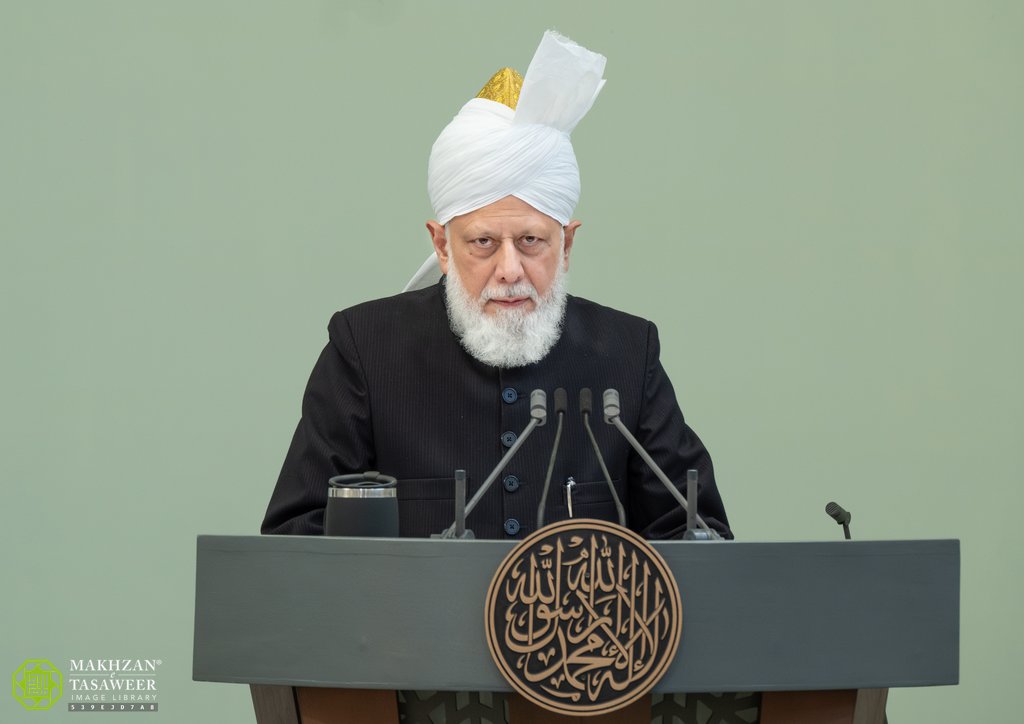
On 28 November 2025, the Worldwide Head of the Ahmadiyya Muslim Community, His Holiness Hazrat Mirza Masroor Ahmad, delivered his Friday Sermon from the Mubarak Mosque in Islamabad, Tilford, UK.
Continuing his detailed series on the Expedition of Tabuk, His Holiness spoke about the truthfulness and courage of early Muslims, drawing lessons that remain relevant to believers and the wider society today.
In the opening part of the sermon, His Holiness explained that when the Holy Prophet Muhammad (peace and blessings of Allah be upon him) returned safely from Tabuk, many of the hypocrites who had refused to join the expedition came to him in the mosque, offering excuses and swearing oaths in order to avoid blame.
His Holiness said that although the Holy Prophet (peace and blessings of Allah be upon him) accepted their outward statements and left their inner reality to God, the Holy Qur’an itself exposed the hollowness of their claims and set a timeless standard of accountability. Citing verses from chapter 9, His Holiness read:
“They will make excuses to you when you return to them. Say, ‘Make no excuses; we will not believe you. Allah has already informed us of the facts about you. And Allah will observe your conduct, and also His Messenger; then you will be brought back to Him Who knows the unseen and the seen, and He will tell you all that you used to do.’”
His Holiness explained that these verses are a warning against any culture in which people seek to shield themselves from responsibility through rhetoric or performative displays, while lacking the substance of service and loyalty.
His Holiness went on to explain that among those who stayed behind from Tabuk there were four distinct groups: those who had been formally instructed by the Holy Prophet (peace and blessings of Allah be upon him) to remain in Medina for necessary duties; those who were genuinely unable to travel due to poverty or illness; the hypocrites, whose conduct the Holy Qur’an strongly condemned; and finally a small group of sincere believers who stayed back purely out of weakness and delay. Of this last group, the Holy Qur’an mentions three companions by category rather than name, highlighting how their guilt and repentance became an everlasting lesson for all Muslims.
His Holiness recounted in detail the personal testimony of one of these three companions, Hazrat Ka‘b bin Malik (may Allah be pleased with him), who openly admitted his fault to the Holy Prophet (peace and blessings of Allah be upon him) rather than fabricating excuses. His Holiness related how Ka‘b bin Malik presented himself in the mosque and, despite knowing that others had escaped reprimand through false pretexts, chose instead to confess plainly that he had no valid justification for remaining behind. Quoting his words as narrated in the sermon, His Holiness said:
“No, by Allah, I had no excuse. By Allah, I had never in my life been in better health and ease than at the time when I stayed behind from you.”
His Holiness explained that this moment of painful honesty became the turning point for Ka‘b bin Malik and the other two companions who stayed behind. Although the Holy Prophet (peace and blessings of Allah be upon him) temporarily instructed the community to suspend social contact with them, and the three men went through fifty days of deep anguish and self-reckoning, their truthfulness and honesty ultimately led to their complete forgiveness and spiritual elevation. His Holiness quoted another powerful statement, again in Ka‘b bin Malik’s own words, to show how this repentance reshaped his entire outlook:
“I said, ‘O Messenger of Allah, Allah has granted me deliverance because of truthfulness, and as part of my repentance I now pledge that I shall always speak the truth for as long as I live.’”
His Holiness stressed that this incident shows how Islam does not merely condemn hypocrisy, but actively honours those who choose truth even when it is personally costly or humiliating. The moral victory of these three companions, which has been eternalised within the verses of the Holy Qur’an, stands in contrast to those who sought to manage appearances through denial and oaths. His Holiness underlined that this incident is a reminder that genuine reform and reconciliation can only begin when people face their failures honestly and turn back to God with sincerity.