Under the Shade of Khilafat: Moments of Grace & Guidance (2024-2025)
A Personal Account
By Abid Khan
Introduction – A Golden Decade, Followed by Seasons of Trial
Over the past year, I have lost track of the number of people who have asked me if and when I would be writing another ‘personal account’ or ‘diary’ about my experiences and observations of the blessed character of Hazrat Khalifatul Masih V (aba). Upon each inquiry, I have felt, in equal measure, gratitude at their interest and embarrassment at my failings to write anything for more than a year.
Most of the diaries I wrote were published during the previous decade and looking back on that time, I am reminded of a piece of advice a close friend and mentor gave me in the summer of 2010.
It was around that time when Huzoor had first instructed me to report daily for Mulaqat.
Upon learning of this, my friend counselled me and said:
“One day you will look back at this period as the ‘golden period’ of your life. So, seek to learn from Huzoor every day and to value and cherish these days for however long they may last.”
Looking back, that advice proved salient and prescient. The ten years from 2010 to 2020 were a decade in which Allah blessed me in ways I could never have dreamed of or imagined.
At a personal level, it was during this period that my wife and I were blessed with our three children.
Above and beyond everything else, it was a unique period during which I spent countless hours in the blessed company of Hazrat Khalifatul Masih V (aba), both in the UK and on many foreign tours.
There are so many treasured memories and special moments etched in my heart from that time that, even if I were to spend every moment of my life thanking Allah, I would still be guilty of vast ingratitude.
In retrospect, the COVID-19 pandemic that swept the world in early 2020 was a demarcation ushering in a new era.
After a period of relentless blessings, it heralded a period of trial and a test of patience for me and for countless others.
It was a time of sadness.
Indeed, it was a time when shocking and painful news seemed to emerge all too often.
It was a period during which my nephew and colleague, Syed Taalay Ahmed, was martyred whilst travelling in Ghana. It was something that shook me to my core and inflicted heavy emotional wounds.
In terms of Khilafat, as COVID restrictions brought much of the world to a standstill, I too found my interactions with Huzoor suddenly limited.
I recall, how at the height of the first lockdown, we found out that Huzoor had fallen in his home and quite severely injured himself. The grief and sorrow felt is hard to describe.
Alhamdulillah, Huzoor soon made a full recovery from his injuries. His personal courage, dignity and resolute devotion to fulfilling the duties of Khilafat shone forth, serving as an exemplary example for the entire Jamaat.
Yet, in spite of his steadfastness, humility and exemplary conduct, the level of hatred and vindictive falsehoods spread online about Khilafat-e-Ahmadiyya and targeting Huzoor’s own conduct and character reached unprecedented levels.
Having witnessed first-hand how Huzoor always set aside all personal interests for the sake of Allah the Almighty and the mission of the Promised Messiah (as), it was, and remains, a source of profound anguish to see such malicious attacks directed towards him.
Often, during the period when such unjust attacks on the character of Huzoor were at their peak, I would feel restless and distressed.
Yet, invariably, when I would meet Huzoor he would reassure me.
For example, I recall how, once, during that period, Huzoor said to me:
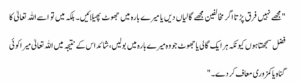
That:
“I do not mind if the opponents of Ahmadiyyat curse me or spread falsehoods about me. In fact, I consider it a blessing, because for every curse or falsehood they direct towards me, perhaps Allah will forgive one of my sins or weaknesses.”
During this same period, it also became apparent that Huzoor’s health had started to suffer. Indeed, on the advice of doctors, Huzoor had a medical procedure in April 2024. Where most people would have taken several weeks to rest and recover, Huzoor immediately returned to his office and duties.
Nevertheless, a consequence of the demands of age and circumstances has been that Huzoor’s foreign tours have decreased in recent years. Yet, his interaction with the Jamaat has not lessened in any way.
Instead, Ahmadi Muslims have been blessed with the opportunity to interact and seek the guidance of Hazrat Khalifatul Masih V (aba) through ‘Virtual Mulaqats’ online.
Furthermore, since the end of Covid restrictions, every week, Ahmadis, either personally or as delegations, have travelled to Islamabad to meet with Huzoor and to offer Salat behind him.
The delegations or groups who meet Huzoor are regularly featured on ‘This Week with Huzoor’ on MTA, and reported on in Al-Hakam and Al-Fazl. And it is chiefly for this reason that I have been reticent to write about events that have already, to some extent at least, been broadcast or reported on.
Thus, in this diary, I will focus on a few incidents from the past year that illustrate the continued way in which Huzoor guides the Jamaat, conveys Islam’s message to others, and I will share some personal memories from recent Mulaqats.
In no way is this a comprehensive account of Huzoor’s activities or engagements. For instance, I have not included an account of the Jalsa Salana UK, various Jamaat events graced by Huzoor or the dozens of group Mulaqats that took place this year. Nor have I mentioned meetings held with dignitaries, MPs and Ambassadors of State this year.
Rather, I seek only to present a few recent incidents or narrations illustrating the wisdom, grace and compassion of Khalifa-Waqt that I was privileged to witness.
A Meeting Deferred, A Message Delivered
Earlier this year, in April, Pope Francis died after a period of illness. During his Papacy the Jamaat, under the guidance of Khilafat, developed a relationship with the Vatican.
Huzoor himself had written to the Pope on several occasions, and representatives of the Jamaat were invited to meet with him.
Furthermore, Huzoor had appreciated certain statements made by Pope Francis.
For example, in 2015, Pope Francis spoke out against insulting the faiths of others, unnecessary provocation, or mocking people’s beliefs. He famously gave the example that if someone cursed his mother, they could “expect a punch in the face.” This was something Huzoor mentioned publicly, appreciating the underlying sentiment of respecting each other’s faiths and beliefs.
Given that the sentiments and attitude displayed towards Islam by the Pope were generally positive, in February 2024, Marwan Gill sahib, our Jamaat’s Missionary in Argentina, requested Huzoor if a meeting between Huzoor the Pope might be arranged.
In response, Huzoor permitted Marwan sahib to explore the possibility and feasibility of such a meeting and instructed him to liaise with me on this matter.
Very soon after approaching the Pope’s office, Marwan sahib received a positive response – the Pope duly invited Huzoor for a private meeting at the Vatican scheduled for 7 November 2024.
Upon receiving it, Huzoor tentatively accepted and permitted the Italy Jamaat to prepare a proposed itinerary for a week-long visit to Italy in November.
Further, in advance of the November meeting, Huzoor graciously permitted me to join a small delegation from the Italy Jamaat to meet Pope Francis in June 2024.
Thus, on 26 June 2024, along with the Sadr Jamaat (National President), the Missionary in-Charge and Sadr Khuddam from Italy Jamaat, I travelled to the Vatican to meet the Pope.
Where the halls and buildings within the Vatican were spacious and grand, the Pope’s office itself was much more intimate. I was later told that the Pope had an additional, much larger, office for receiving guests but, generally, he preferred to work and receive visitors in the smaller room.
It was a very interesting experience. I was struck by how there were certain practical similarities in the way the Pope’s meetings were arranged and those of Hazrat Khalifatul Masih (aba).
For instance, we learned that the Pope held his official office meetings in the morning. Thus, upon arrival at 8am, we were escorted to a waiting room, where a Cardinal and a European Ambassador were already present, waiting to meet the Pope.
First, the Cardinal was received, followed by the Ambassador. Then, the Pope’s Private Secretary invited us into the Pope’s office.
The Pope’s staff gave the impression that the Pope would meet us very briefly for a minute or two at most. However, upon entry, we found Pope Francis to be warm and relatively informal. He knew the Jamaat quite well remembering his previous interactions with our representatives.
The Pope seemed genuinely pleased to learn about the Jamaat’s efforts to promote interfaith harmony and dialogue and expressed appreciation upon hearing of how Hazrat Khalifatul Masih V (aba) sought to convey Islam’s true teachings of peace and justice around the world. Then, when our 15-minute meeting concluded, small gifts were exchanged, and official photos were taken. It was apparent that after witnessing the Pope’s friendly attitude and the fact that he had granted us more than the allotted time, his Private Secretary and staff were noticeably warmer towards us post-meeting.
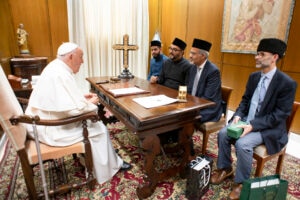
Upon returning to England, I informed Huzoor about the visit and what transpired. I showed him a photo of the meeting, which Huzoor very briefly glanced before resuming his work.
I was hopeful of the possibility of Huzoor meeting with the Pope later in the year. At the same time, despite Huzoor having tentatively accepted the invitation, I knew it did not mean it was certain to go ahead.
I had long observed that before any major visit or tour, Huzoor would pray and reflect before reaching a final decision to proceed. Thus, there have been occasions when a planned foreign tour or a meeting with a world leader was cancelled by Huzoor following a period of prayer and reflection.
The proposed Vatican meeting remained in question for several months until, one afternoon in early October, when, during my Mulaqat, Huzoor said:
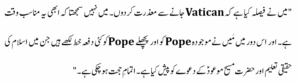
“I have decided to send apologies for the visit to the Vatican. I do not think this is the right time (for the meeting). Moreover, during this period of Khilafat, I have written several letters to the Pope and to his predecessor in which I conveyed the true teachings of Islam and presented the claim of the Promised Messiah (as) – the message has been delivered.”
Huzoor duly instructed me to inform Marwan Gill sahib to convey his apologies to the Vatican.
Thus, while most people, in order to elevate their status in the eyes of the world or to feed their egos, would not pass on the opportunity to meet some of the world’s most powerful or influential people, Huzoor has no such desires or objectives.
Rather, Huzoor’s desire is only to guide people towards God Almighty and to further the message of the Promised Messiah (as) and to defend and promote Islam’s true teachings across the world.
A meeting between Huzoor and Pope Francis was not destined to take place. However, Huzoor’s regard for the Pope was evident in a statement of condolence he gave upon the Pope’s death.
Huzoor said:
“I was deeply saddened to learn of the passing of His Holiness Pope Francis. Throughout his life, Pope Francis sought to serve the poor and vulnerable, demonstrating immense sympathy for those suffering under the heavy weight of warfare, persecution, and injustice. He was a man of compassion, humility, and faith who strived to build bridges between people of different faiths and beliefs.”
Covering Eyes & Ears
One evening amidst the bitter cold of January this year, during Mulaqat, I presented some feedback we had received to an episode of ‘This Week with Huzoor’, in which many people had written to express the benefit they derived from viewing it.
In the episode, in response to a question about a successful marriage, Huzoor had stated that a husband and wife should manifest understanding and grace to one another.
As he had stated on previous occasions, Huzoor remarked that the key to a successful marriage was for each partner to “cover their eyes and ears” when it came to what they considered weaknesses in their spouse.
After presenting the feedback, I asked Huzoor a question about this.
I said:
“Huzoor, you often advise newlywed couples to cover their eyes and ears to the weaknesses or flaws of one another. However, there must be some point where a husband or wife may need to address a fault they perceive in their spouse?”
Upon hearing this, Huzoor smiled and indicated for me to give an example.
In reply, I said:
“For example, if a husband sees that his wife does not offer Salat?”
It was not out of any personal concern or experience that I asked this question or gave such an example. Rather, it was raised only with a desire to fully understand Huzoor’s guidance.
Thereafter, Huzoor said:
“If a husband observes that his wife does not pray, he should very lovingly and with great consideration for her feelings explain the fundamental importance of Salat. Moreover, if they have children, he should mention how it is essential that both parents set a good example for them. Nonetheless, he should not resort to harshness.”
Huzoor continued:
“Remember, when it comes to Salat, the Holy Prophet (sa) stated that only between the ages of ten and twelve is it permissible for one’s parents to exhibit firmness. Thus, it does not behove a believer to force or harshly treat his spouse regarding prayer.”
I thought about the wisdom underpinning Huzoor’s words. The guidance of covering one’s eyes and ears is indicative of the unique relationship of a husband and wife and how they have been deemed by the Quran to be ‘garment’ for one another.
Huzoor’s guidance underscored that for any marriage to be successful mutual understanding and trust were fundamental. Moreover, keeping a family unit closely knit to ensure a stable environment for one’s children was itself a major virtue.
Thus, where a husband and wife start pointing out one another’s flaws or weaknesses it would undermine the unity and strength of their home.
The Grooming Gangs: Separating Fact from Fiction
Over the past year, there has been a lot of media coverage and public outrage about what has become known as the ‘grooming gangs’ issue here in the UK.
The grooming gangs refer to dozens of men, mostly of Pakistani origin, who were convicted in recent years of atrocious sexual crimes against young girls.
A great deal of focus has been placed upon their ethnicity and, invariably, powerful and influential people with their own agendas have used these crimes to stoke hatred of immigrants and Muslims in particular.
Given that most of the Ahmadi Muslims in this country are of Pakistani origin, it is something that has been extremely painful to view and read about.
On the one hand, a natural revulsion and disgust at the evil crimes committed is felt, whilst on the other hand, grief and frustration that agenda-driven people have sought to conflate Islam with such crimes and to tarnish the reputations of all men with a Pakistani background.
Earlier this year, I informed Huzoor about this issue.
Upon learning its details, Huzoor said:
“Those opposed to Islam and Muslims are exploiting this issue by seeking to associate Islam with such heinous crimes. Yet, according to Islam’s teachings, the punishment for rape and sexual assault is very severe and far harsher than in non-Islamic societies. Indeed, the punishments mandated by Islam for such crimes would be classed as ‘draconian’ by those who are trying to link Islam with such atrocious crimes.”
Huzoor continued:
“Islam’s philosophy and teaching is that harsh punishments are necessary for certain crimes to serve as a deterrent and to underscore the heinous nature of the crime.”
Another report I presented to Huzoor that day was about how Meta, the company that owns Facebook and Instagram had announced they were abandoning the use of independent fact-checkers as a means of ensuring ‘free-expression’.
Upon hearing this, Huzoor stated:
“So for the sake of profit, they are ready to permit and promote even more ‘fake-news’, which in turn will lead to even more hate and division spreading online. It is the height of selfishness.”
From Hearts to Huzoor – Clarity through Technology
Viewers of ‘This Week with Huzoor’ may have noticed an iPad is often visible on the table in front of Huzoor.
The reason is that, sometimes the accents of those who come to meet Huzoor are quite strong and distinct. Additionally, due to nerves, they often speak too quickly or quietly. As a result, their words or questions are sometimes unclear.
Over the years, in such situations, Huzoor often asked me to clarify the question or point being made. If it was a short question, I would manage reasonably but where questions were long or complex, it was sometimes difficult for me to convey the point quickly and accurately.
As a result, during the Covid period, when Virtual Mulaqats began, I proposed to Huzoor that I could connect an iPad to my laptop. The idea was to type the questions on the laptop, allowing Huzoor to view them on the iPad if an accent was unclear. After I demonstrated the setup – showing how the typed text appeared instantly – Huzoor graciously approved the idea.
By the Grace of Allah, this system has generally worked well, aside from a few occasions when the iPad and computer connection failed during a Mulaqat.
An Orange Tree, A Mango Tree
Over the past year, Huzoor has graciously met with several Khuddam delegations from the United States who have travelled to Islamabad to spend a few days in the close proximity of Khilafat.
Initially, the US Sadr Khuddam had proposed one large group of several hundred Khuddam from across America to visit Islamabad. However, Huzoor instructed that the Khuddam should come in smaller groups so he could become personally acquainted with each individual. This instruction required Huzoor to commit far more time and is demonstrative of the sincere desire of Khalifa-Waqt to enable Ahmadi youth to form a close, personal connection with Khilafat.
During the Mulaqats, the Khuddam have the opportunity to introduce themselves and to ask Huzoor whatever questions they have in their hearts.
It was during one of these Mulaqats earlier this year, a Khadim asked Huzoor why Muslims, when reciting Durood, pray for the Holy Prophet (sa) by referencing Hazrat Ibrahim (as) and his people.
In response, Huzoor gave a detailed answer explaining that the potential for blessings and prosperity inherent in the Prophethood of Hazrat Ibrahim (as) was realised to its maximum potential through the birth of the Holy Prophet (sa) from his progeny.
As a result, Huzoor said that when we offer Durood, we are praying for the full realisation of Islam’s potential. We are asking Allah to enable the achievement of all potential blessings and prosperity associated with the Holy Prophet (sa) and Islam – a potential far greater than that of any other Prophet or religion.
I enjoyed and learned a lot from Huzoor’s answer and so, later in the day, during Mulaqat, I expressed gratitude to Huzoor.
In response, Huzoor mentioned how he had given the example of an orange tree and a mango tree. Huzoor had said that the potential yield of an orange tree is limited to 1,000 or 1,500 oranges, whereas a mango tree had the potential to yield thousands of mangoes.
With great humility, Huzoor said:
“I was not sure if the example of a fruit tree I gave was understood by all the Khuddam. My point was that orange trees have a certain potential to yield fruits, whereas mango trees have a much higher potential yield. Thus, the spiritual tree of Hazrat Ibrahim (as) reached its pinnacle and fulfilled its potential through the advent of the Holy Prophet (sa) from amongst his progeny.”
Huzoor continued:
“However, the blessed spiritual tree of the Holy Prophet (sa) has far greater potential than that of any other Prophet, as his was a universal teaching for all people and all times. Thus, when we pray that may Allah bless the Holy Prophet (sa) as he blessed Hazrat Ibrahim (as), it means we pray that may Allah the Almighty enable for the true potential of Islam to be realised and for the unparalleled blessings of the Holy Prophet (sa) to spread to all peoples and nations.”
No doubt, Huzoor’s background as an agriculturist and taking care of fruit orchards inspired this simple, yet profound example, which so beautifully conveyed the true meaning of the Durood prayer.
Africa Rising, Guided by Justice
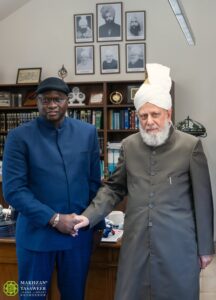
Earlier this year, Mr Ndao Saer, a representative of the President of Senegal, travelled to Islamabad to meet Huzoor in his office.
Throughout the meeting, Huzoor’s guidance to the Senegalese guest was captivating and illustrated Huzoor’s continued love for the African Continent and his desire to see it progress and prosper.
When the Mulaqat started, Mr Saer outlined the purpose of his visit. He said:
“Your Holiness, our nation’s President took office and formed a new Government recently and so he has sent me to seek your guidance and advice on how best to govern.”
In response, Huzoor said:
“Whenever any Government is elected by the people, the Government should consider it a ‘trust’ placed in them by the public. Certainly, the people choose their leaders and government with the hope and belief that they will strive to better their lives. Thus, the Senegal Government and its leaders can only fulfil this trust and raise the standards of living if they fulfil the demands of justice and honesty. Fundamentally, it is essential that the law of the land and the constitution apply equally to all, not that there is favouritism or any deviation from the principle of justice.”
Huzoor continued:
“You should sincerely seek to care for your people so that they realise and perceive that you love the nation and its people and seek to serve them. Then, the public will support you.”
Speaking about the fundamental need for truth and integrity amongst public servants, Huzoor said:
“In many developing nations there is great weakness in terms of people paying their taxes but if the public has trust in the government and are confident that their money is being used with honesty and integrity for the betterment of the nation, they will pay it.”
Very beautifully, speaking about what leadership requires, Huzoor said:
“The President, all elected members of the government and politicians should remember and realise that they have not been elected to rule over the people, rather they have been elected to serve them. The vast majority of your people are Muslim and so always remember the principle taught to us by the Holy Prophet (sa) that a true leader is a servant of their nation. If you act in this way then your government will succeed and your nation will prosper.”
As the meeting progressed, the guest sought Huzoor’s further guidance.
Upon this, Huzoor spoke about the value of education and urged the Government to do all they could to ensure that all children and young people had access to higher education, irrespective of their background.
Huzoor said:
“A fundamental point for any nation to prosper is to enhance the educational standards and so you should ensure that high-quality education is available across the country for boys and girls. Further, instil in your people a belief that attaining primary or secondary education is not sufficient. Rather, higher education should be pursued, and the government must provide access to higher education for all citizens. This is an investment that will reap great long-term fruits.
Huzoor also spoke of the need for African countries and their people to be ready to take a position of leadership in the world.
Huzoor said:
“We are passing through extremely turbulent times. The world, especially in Europe, is increasingly entangled in warfare. Who knows where it will lead to and the destruction that will be caused. So, developing nations should strive to raise their standards and excel.”
Huzoor continued:
“Certainly, I believe Africa has the potential to step into the vacuum of world leadership and the resulting instability – but it requires African governments to act with justice and integrity at all times and to serve their nations faithfully. If you are successful in this then your nations can lead the world.”
Thereafter, very powerfully Huzoor spoke of how Islam rejected all forms of racism and that the potential and capabilities of any people was not governed by the colour of their skin.
Huzoor said:
“Do not think that the people of Europe or the West have been blessed with more intelligent minds or that their brains are more developed than the people of Africa or Asia. The reason they have had success is that their people, for the most part, are hard-working and observe the laws of the land. If your people and nations can instil these qualities, then undoubtedly you can develop at pace’
Huzoor further said:
“Thus, it is my prayer that your nation and Africa as a Continent may continue to progress and succeed and that one day you may come to lead the world!”
Later, Huzoor also spoke of the importance of freedom of expression and belief.
Huzoor said:
“Remember that freedom of expression and opinion, as well as freedom of religion are cornerstones of a free society. If these freedoms exist then the nation is free. So, let people have the confidence to practice their religions and beliefs and let them air their views and opinions without fear. If this freedom exists then your people will be content and support the Government and know that you are on their side. However, if such freedoms are curtailed or limited in any shape or form – that is when problems arise. Frustrations and grievances develop.”
Finally, addressing the security situation in Africa, Huzoor said:
“The security of your nation is paramount. Terrorist groups like Boko Haram, Daesh or Al-Shabab have created bases in Africa and caused misery and terror. If you wish to save Senegal from such poison and terror you must focus on the improving the economy. If opportunities for economic progress exist then these groups do not have the oxygen to spread. Terrorist groups exploit those countries or regions where corruption and lawlessness exist and where public trust has eroded.”
As the meeting drew to a close, Huzoor spoke of the importance of humility in leaders, reminding them they would be held accountable for their actions.
Perhaps Huzoor was thinking of a concern I had heard him express previously – how some African leaders refuse to leave office, remaining in power for decades through a combination of coercion and corruption.
Huzoor said:
“Convey my message to your leaders and politicians that they should always remember that Allah the Almighty is forever watching over all of us. He knows what we do and so do not think that ‘we are untouchable’ or that ‘no one sees what we do’. Having ‘power’ or ‘authority’ is only of benefit if it is used for the betterment and benefit of the public.”
Huzoor said:
“Serving your people and seeking to improve their lives is the means of showing gratitude to God for the blessings He has bestowed upon you. It is the means of pleasing him. Ingrain this point within your leaders. If they remember this, they will succeed and be blessed. Remember that one’s honour and prestige lies in service not in power.”
Blessings in Broadcast – Huzoor’s Continued Guidance
Alhamdulillah, the News Department within MTA has the honour to produce ‘This Week with Huzoor’. The normal procedure is that, with the help of MTA’s Production Department, we produce a draft edit of the programme and present it to Huzoor for his final approval.
Some weeks, Huzoor graciously approves it as submitted, whilst, at other times, he instructs us to make certain edits.
Where Huzoor may sometimes instruct us to make a change, at other times, Huzoor may suggest a change or the addition of a particular question or part of a Mulaqat.
Then, after giving the suggestion, very beautifully Huzoor often says:
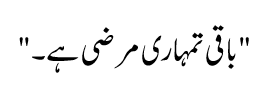
That:
“The rest is up to you!”
Regarding administrative matters, it is very beautiful to observe the sagacious balance in Huzoor’s guidance. While he gives direct and firm instructions on certain matters, at other times, Huzoor may offer a suggestion or an idea, whilst leaving a degree of discretion to the person or people charged with a particular duty or project.
Nonetheless, from our side, of course, wherever Huzoor gives a suggestion or even a hint, we consider it our good fortune to obtain his guidance and a duty and honour to follow it.
We have always witnessed how there are only blessings in following whatever Huzoor suggests. One small example is that after the UK Jalsa this year, in successive episodes we broadcast highlights or some of the delegations who met Huzoor during and after the Jalsa.
Just as we were about to finalise the second episode, Huzoor said:
“Though you did not show every single Mulaqat, you can list the names of all countries at the end of the episode of the delegations who met me.”
Based on this guidance, we rescripted the voiceover at the end of the programme to include the names of the countries as Huzoor had instructed.
Later, we received feedback and comments from Ahmadis in which they commented on the sheer number of countries listed and how it was astonishing that Huzoor had somehow managed to meet and receive so many groups in such a short period of time.
Arguing with Purpose, Not for Ego
In terms of administration, Huzoor also graciously guides us if ever there is a difference of opinion between departments or people.
Earlier this year, I received a letter from a senior member of the MTA International management about the scheduling of ‘This Week with Huzoor’.
It mentioned that a matter had been presented to Huzoor regarding its scheduling and Huzoor had given an instruction that was being sent to me for implementation.
When I read the letter, I felt that a pertinent detail had been misunderstood and inadvertently misrepresented before Huzoor.
I felt moved to respond to the letter.
In what feels like another lifetime, I was once trained as a lawyer and trained to find loopholes or inaccuracies. Moreover, we were taught to draft arguments in a legal way and, occasionally, in my Jamaat work, I have the opportunity to exercise some of the latent legal skills I learned at university. This was one such occasion!
As a result, I wrote a detailed response to the letter, in which I highlighted what I considered to have been misrepresented.
I drafted and redrafted the response at least three times.
The first version was strongly worded and emotional, the second less so, and the final version was written with what I hoped was due respect and cordiality.
Nonetheless, I later received a call from another MTA Director who said he could sense my distress and emotion just from reading the letter.
Hearing that my supposedly ‘neutral’ final draft conveyed this impression, I was extremely relieved that I had not sent the initial draft!
Given that the matter had already been presented to Huzoor, I also sent a copy of my response to Huzoor.
The next day, as I was leaving Huzoor’s office after Mulaqat, he called me back momentarily.
Smiling, Huzoor said:

That:
“You are currently engaged in a dispute about the scheduling of ‘This Week’.”
Huzoor then informed me of the concern presented to him by the senior member of MTA to him.
In reply, I briefly explained my perspective and point.
Thereafter, once again with a smile, Huzoor said:

That:
“There is no harm to fight for something which is of benefit or can lead to an improvement, in fact it is a good thing.”
Of course, Huzoor did not mean that conflict was desirable. Nor should one ever resort to bitterness or discourtesy. However, where there was a difference of opinion, in order to reach a better outcome, it was appropriate, and indeed a positive thing, to argue one’s case, so long as one was motivated by seeking a greater good, not the fuelling of one’s ego.
I took Huzoor’s comment as a sign that he was happy for me to continue to argue my case, though he did not say whether he thought I was in the right or wrong.
Thus, as I left Huzoor’s office, I said:
“In our Jamaat administration, even if we have our own personal beliefs or views, we are all happy and satisfied with whatever Khalifatul Masih decides. Whatever Huzoor decides will be for the better.”
Thankfully, it was a relatively small and trivial matter which was resolved amicably and to the satisfaction of all parties within a few days, according to the guidance and direction of Huzoor. Alhamdulillah.
A Human Hand, A Heavenly Shield
Occasionally, during Mulaqats, I mention questions that I am asked by Ahmadis in relation to our beliefs or Nizam (administrative system).
Accordingly, in a Mulaqat earlier this year, I mentioned that a Khadim had asked me if it is a matter of faith for an Ahmadi to believe that everything the Khulafa say shall be fulfilled to the letter.
Most graciously, Huzoor set aside the file he was reviewing and answered this question at some length.
Explaining how the Khulafa come to form a view, Huzoor said:
“When the Khulafa of the Promised Messiah (as) state something about the world or make a prediction about the future it is based on various factors. For example, they may reflect on certain episodes from history, the current situation of the world and use their knowledge and intuition based on the teachings of the Quran, the Holy Prophet (sa) and the Promised Messiah (as). However, they do not claim to be making a ‘prophecy’ like the Prophets. This is an important point to note.”
Huzoor further said:
“On most occasions, what the Khulafa have said has come to fruition, whether in the near future or at a later time. However, if ever, circumstances do not arise as they have suggested it is not something that should weaken the faith of an Ahmadi. Rather, it should be kept in mind that Allah is the Master (Malik) and so He has the ability to change His decision or decree at any time.”
Thereafter, responding directly to question, Huzoor said:
“So, it is not necessary that every decision or statement of the Khulafa will always be perfectly correct. The Khalifa-Waqt is a human being and can make errors in judgement. He is not infallible.”
Huzoor continued:
“However, it is our faith – and the history of the Jamaat bears witness to the fact – that, if ever, the Khalifa-Waqt says something incorrect or makes a decision that may not have been right, it does not lead to long-term harm to the Jamaat or the mission of the Promised Messiah (as).”
Most beautifully, Huzoor further said:

That:
“This is because every word that I have ever spoken has been uttered with the fear of Allah ingrained in my heart and it was the same with the past Khulafa.”
Before returning to his work, Huzoor said:
“The Khulafa do not speak or act according to their personal interest, rather whatever they say is governed solely by their desire to fulfil the commands of Allah the Almighty and to further the blessed mission of the Promised Messiah (as). And the way Allah protects and shields the Jamaat from those who wish it harm is a great proof of how Allah’s Help is with the Promised Messiah (as) and his Khulafa.”
Reports from Gaza – Trusting in Allah Amidst the Turmoil
Over the course of the past two years, the situation in Gaza has been a source of perpetual sadness and grief.
Thousands upon thousands of Palestinians have been killed, including scores of innocent women and children. It is something that we have all witnessed and felt pained by. No doubt, it is something that the Khalifa-Waqt feels even more deeply.
Throughout his Khilafat, Huzoor has advocated for the rights of innocent and defenceless people and warned of how the peace and security of the world is being undermined on a daily basis. All his warnings of increasing conflict have been proven true.
As I write, the situation continues to be grave. Though a ‘ceasefire’ was recently declared in Gaza, it seems Israel is free to resume its bombing campaign at will with impunity.
Throughout this period, I have presented reports and updates to Huzoor. In addition, Huzoor receives reports from various other sources including from the ground itself.
Soon after Donald Trump took office as President of the United States in January 2025, a ceasefire in Gaza was announced.
At the time, I mentioned the ceasefire to Huzoor.
In response, Huzoor said:
“I do not think this ceasefire will last. Israel will resume the war at some point. Moreover, it seems clear that it is the objective of the Israeli authorities is to take control of more and more Palestinian land. Their eyes are set on both the West Bank and Gaza. Who knows what, if anything, will be left for the Palestinians at the end?”
In response, I said:
“The world is becoming ever more dangerous, just as Huzoor has warned for many years.”
Upon this, Huzoor said:
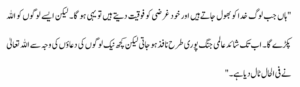
That:
“Yes, when people forget God Almighty and give priority to selfishness then this is the natural result. Nonetheless, Allah will hold to account such people. Perhaps a world war would have fully erupted by now if it were not for the prayers of some righteous people that Allah the Almighty has delayed it for now.”
Hearing this, I was moved to say:
“Huzoor, it is your prayers that Allah listens to the most and so it is the effect of your prayers.”
A few months later, Israel had, as Huzoor had predicted, long resumed its war in Gaza. Day after day and night after night, Israeli bombs rained down upon utterly defenceless people. By now, the term ‘genocide’ was starting to be used much more openly to describe what was taking place.
At the same, Israel also launched a war against Iran that lasted almost two weeks and which concluded when the United States joined this war and launched so-called ‘bunker busting bombs’ in Iran.
It was during this period, in mid-June, that I presented the latest report to Huzoor.
In response to hearing of the latest Israeli attacks in Gaza, Huzoor said:
“Their cruelties have gone beyond all limits.”
It felt as though the Israeli government could do as it liked and no one had the power or ability to rein them in or stop them.
Thus, I asked Huzoor directly,
“Huzoor, is there anyone who can stop their cruelties?”
Upon this, Huzoor looked up at me and with an expression filled with awe and in a tone that gave testimony to his absolute conviction, Huzoor firmly said:

That:
“Allah the Almighty can stop it. And if you or anyone else has even the slightest doubt about this they should increase their faith.”
Huzoor’s words and tone conveyed his utter conviction and complete trust in the power and majesty of Allah the Almighty and hearing them sent a shiver down my spine.
Declining an invitation
As bombs and bullets continued to pound Gaza over the past two years, it has been interesting to note that, for the first time, many people have found the courage to raise their voice against the policies of the Israeli government.
Where the fear of being labelled ‘anti-Semitic’ was once enough to silence debate, the progressing brutalities have emboldened an increasing number of voices to openly criticise the government of Israel.
As the Israeli Prime Minister himself has mentioned social media has itself become a battleground in which pro-Zionist and pro-Palestine voices have sought to sway public opinion.
Some social media influencers and prominent people have either publicised their experiences from funded trips to Israel or disclosed that they were offered, but refused, such paid visits.
In this regard, recently, the Israeli Consulate in a Western country also sent an official invitation for an ‘all-expenses-paid trip’ to Israel to the Jamaat’s National Secretary Umoor-e-Kharija. The invite explicitly stated that it was directed at “those whose words matter in their communities”.
When I duly mentioned the invite in Mulaqat, Huzoor made it clear that the invitation should be declined and that it would not in any way be appropriate for a representative of our Jamaat to go on such a visit.
It is true that, under the guidance of Khilafat, Ahmadis have always sought to promote interfaith dialogue and harmony with people of all faiths, whether Christians, Jews, Hindus or any other. At the same time, it is also true that the only world Muslim leader who has consistently and repeatedly condemned the cruelties in Gaza from the outset has been Hazrat Khalifatul Masih V (aba).
In sermon after sermon, Huzoor has expressed his condemnation and called on members of the Jamaat to advocate peacefully for the rights of the Palestinians.
In Gaza, Every Hour a Year
Where Huzoor has felt pain and grief for every single innocent person in Gaza, no doubt his concern and prayers extend especially for the Ahmadis living there.
A few weeks ago, I recall that I updated Huzoor about how the Israeli army was engaged in heavy firing and strikes targeting Gaza city.
Upon this, Huzoor said:

That:
“Find out from Dr Aziz Hafiz (Chairman Humanity First UK) if all the Ahmadis are safe.
In reply, I mentioned to Huzoor that I had met Dr Aziz sahib three days previously and he had, at some length, told me about the situation on the ground in Gaza.
I was just about to inform Huzoor of the details of our conversation but, before I could say anything further, Huzoor said:
That:
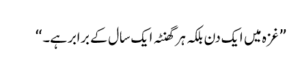
“In Gaza, one day, in fact one hour, is equivalent to one year.”
Huzoor told me how he was getting daily updates but he wished to know what was the state now at this minute.
I felt regret at my mention of the three-day old report and quickly texted Dr Aziz sahib. Thankfully, he saw my message quickly and replied to inform that the Ahmadis were safe. Most had moved to another area, where there was less bombardment currently taking place, though one family remained dangerously close to the line of fire.
As soon as I gave the updated report to Huzoor, he asked me once more to confirm that Dr sahib was informing that the Ahmadis were currently safe.
Upon my confirming Dr sahib’s report, I could feel a sense of relief and comfort appear on Huzoor’s face.
A Love Without Borders
In April, I travelled to the United States for a week to attend some events hosted by Majlis Khuddamul Ahmadiyya in various cities along the East Coast. The visit coincided with the Easter break and so, with Huzoor’s gracious permission, I took the opportunity to take my two elder children, Mahid and Moshahid, with me.
Whenever, I have been sent by Huzoor on behalf of the Markaz to visit another Jamaat, I find it to be challenging and often uncomfortable. Invariably, during such visits, as a guest of the Markaz, you are treated with respect and are asked to sit at the front, deliver speeches or take part in question and answer sessions.
Above all, when representing the Jamaat in any capacity, I am fearful of acting or saying anything that may reflect in a negative way on Khilafat.
Another source of tension prior to the visit stemmed from media horror stories about foreigners, even those with valid visas, being detained upon arrival in the United States.
Reports circulated of deportations or innocent people being incarcerated. Indeed, a lawyer friend in the U.S. had warned me about these potential risks and even kindly offered to travel to New York (our arrival city) in case of any immigration issues.
Given, especially, the fact that my children would be with me, I was somewhat anxious and so prior to the visit, I sought Huzoor’s prayers.
In reply, Huzoor prayed that:
That:
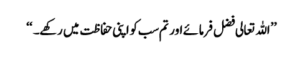
“May Allah the Almighty bless you and keep you all in His protection.”
With these prayers behind us, we travelled to the United States and arrived in New York late one evening in early April.
I had warned my children about the reports of people with valid visas being questioned or even detained just in case anything happened. Thus, after exiting the plane, both of them were nervous as we stood in a long immigration line. I reassured them that because Huzoor had prayed for us, Insha’Allah, everything would be fine.
Finally, when we reached the immigration counter, the immigration agent looked at my passport and that of Mahid and Moshahid. I waited for the inevitable first question about the purpose of our visit. And I wondered what questions would follow thereafter. Yet, to my genuine astonishment, that first question never came.
Instead, he smiled and said, “Have a good trip” and gestured for the next person in the queue to come forward.
We were at the immigration counter for all of 30 seconds.
The process was so quick that when we exited and met with the Regional Qaid of New York who had come to receive us, I asked him to confirm that there were no more immigration counters ahead and that we really had been granted entry.
As we drove towards the accommodation, stopping briefly for some New York pizza, which we ate in the car, I thought of how, with the Grace of Allah, everything had proven so easy and smooth.
No doubt Huzoor’s prayers had protected us from any difficulty. Alhamdulillah.
On a much more trivial note, the slices of pizza were far and away the largest slices that we had ever encountered and, despite being extremely tired, Mahid and Moshahid’s eyes popped wide open as they saw the pizza, which proved a delightful first taste of an array of American foods that they were able to sample during the visit!
By the time we had arrived at our accommodation it was midnight in the United States and so it was the middle of the night back in the United Kingdom. As a result, I did not inform Huzoor immediately that we had arrived safely. Instead, I decided to wait until it was morning time in the UK.
We soon fell asleep but due to jet lag, I woke up after two or three hours. I glanced at my phone and I saw a message from Huzoor enquiring if we had reached safely.
I was so grateful for Huzoor’s love and concern, whilst feeling highly embarrassed that Huzoor had enquired himself about our arrival, rather than me informing him first.
Over the next week, Mahid and Moshahid enjoyed their visit a great deal. That they remained safe and well throughout the trip was no doubt a result of the continued prayers of Huzoor.
Indeed, during our travels, I received messages from Huzoor specifically enquiring after them, asking whether they were well and not suffering from jet lag or exhaustion.
In terms of work, with the Grace of Allah, all events during our stay went well.
Though hosted by Khuddamul Ahmadiyya, each event was open to all members of the Jamaat. The format remained the same throughout – a talk followed by a Q & A session.
At each place, I mentioned that, prior to visiting the United States, I had mentioned to Huzoor that some Ahmadis, who lived in the United States or other countries far away from the Markaz, might wonder if Huzoor loved them in the same way he loved those Ahmadis who lived near him or he personally knew.
Upon hearing this thought, Huzoor said:
“If anyone – Khadim or any Ahmadi – wishes to know about the love that I feel for them, you should remind them of what I said in Germany several years ago, that whilst awake and asleep there is not a single Jamaat that does not pass through my mind and for whom I do not pray. This remains the case and always will.”
Very beautifully, Huzoor said:
“The truth is that all of the Khulafa have always had sincere love for every Ahmadi, wherever in the world they may be, because they have associated themselves with the Promised Messiah (as).”
Thereafter, Huzoor gave a glimpse into his own feelings of love towards Ahmadis.
In words filled with immense emotion and love, Huzoor said:
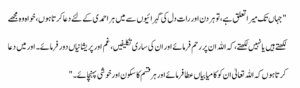
“On my part, each day and night, from the depths of my heart, I pray for every single Ahmadi, whether they write to me or not, that may Allah have mercy on them and may He remove all of their distresses, their pain and their suffering. I pray that may Allah grant them success and all forms of peace and happiness.”
Very movingly, Huzoor added:
“Thus, the love that the Khulafa have for members of the Jamaat is an innate and everlasting love that lies deep in the heart of the Khalifa… Nowhere in the world will you find such love as the bond that exists between the Khalifa and the members of the Jamaat of the Promised Messiah (as).”
It was evident at each event in the United States that these words of Huzoor had a deep impact upon the local Jamaat members. Many, many people came up to me after each event asking me to convey their gratitude to Huzoor and their love and loyalty for Khilafat.
In terms of the Question and Answer parts, I felt especially nervous and fearful of saying something wrong. Everyone is aware of their weaknesses, and I am no different. I am not, by any standard, a scholar and my religious knowledge is particularly weak.
When asked a question, I sometimes struggle to respond adequately in the moment. Many times, after I have given my answer, I have found that a much better one comes to my mind immediately after the discussion ends.
When I was a lot younger, I recall being sent to the United States to attend a Jamaat Media Conference. As a guest of the Markaz, I was asked to speak in front of everyone. I did not wish to expose my ignorance and so tried in vain to pretend I knew all the answers. The result was that I spoke quite incoherently.
Conversely, over the years, I have seen how Huzoor responds to every question asked of him. The vast majority of times, Huzoor answers the question beautifully, according to Islam’s teachings and to the questioner’s satisfaction. Occasionally, though, I have seen Huzoor, with true humility and without any complex, respond by saying he will research the topic further and then provide an answer later.
Thus, I have learned from Huzoor that if I do not know the answer to something, it is better to simply admit it and to avoid pretence of any kind.
During the events, I soon learned that having my children present was a good means of keeping me humble and grounded!
At all times, even when I was delivering speeches or taking part in formal events, I would try to keep an eye to make sure that they were behaving, content and, above all, safe and sound!
The thought of something bad happening to them in any circumstances is greatly distressing but, when I had specially sought Huzoor’s permission to bring them with me and also separated them from their mother for a few days, the pressure and fears were incalculably intensified.
A Missed Moment, Yet Forever Cherished
One Monday, in late April, a few days after our return from the United States, Huzoor called me to his office at 11.15am and, over the next 90 minutes, gave me dictation for his forthcoming addresses at the Waqf-e-Nau and Waqfat-e-Nau Ijtemas.
I spent the next few days typing up and revising the draft according to the instructions received from Huzoor.
After an intense few days of work, I submitted the drafts to Huzoor on Friday afternoon. Since the work meant I had hardly seen my family that week, when my wife Mala mentioned a list of urgently required groceries, I told her that because I was now free, I would go and get them.
She had also had a busy week at home, so when I volunteered to get the groceries, she decided to rest for a few minutes.
Though my trip to Sainsbury’s was well-intentioned, it was one I soon came to regret.
Those familiar with Sainsbury’s in Farnham may know that phone and internet reception is often sparse. Consequently, WhatsApp messages or calls are usually not received until one has exited the store. Thus, after completing my shopping and exiting, I noticed several missed calls and messages from home.
Just as I was about to call back, I saw the phone ring again. It was Mala and as soon as I picked up, she seemed breathless and flustered.
She said:
“You made a big mistake going to Sainsbury’s!”
I was panicked wondering what had happened.
She then said:
“And I made a big mistake falling asleep!”
I was even more panicked wondering what was going on and if our children were ok.
I said frantically:
“What has happened? Is everyone ok?”
In reply, she said:
“Huzoor came! Huzoor came to our house! You were not here and I was half asleep!”
She then added:
“Huzoor came to see the shed!”
Amid the confusion, I was overwhelmed with emotions.
I was relieved that everything was well. Where I was delighted to hear Huzoor had visited, I was also desperately sad to have missed him.
Once I got back home, Mala and our children told me how Huzoor’s visit had unfolded.
A few months earlier, in December, we had a new shed built in our backyard. Once it was built, I furnished it and requested Huzoor if he would come and inspect it.
During the winter period, Huzoor had not taken any walks in the Islamabad premises and so the possibility that Huzoor might visit us was not at all in my thoughts. Likewise, when I had Mulaqat just an hour before Huzoor had visited, he had not given any hint of a visit.
My son Mahid told me how, soon after I had left, they had become aware that Huzoor had come out for a walk and so he and his brother Moshahid rushed outside and both were lucky enough to receive a chocolate from Huzoor.
A few moments later, Huzoor called Mahid back and asked if our daughter Jaweria had received a chocolate or not. Mahid said she was still at home. Thus, Huzoor most kindly said that Mahid and Moshahid should go and get their sister so she too could receive a chocolate.
Mahid told me that because Huzoor had given him this duty, he ran faster than he had ever run before!
As soon as they reached home, they woke Mala and exclaimed, “Huzoor is calling Jaweria”.
Shoes quickly put on, her brothers led Jaweria outside and, upon doing so, they saw that Huzoor was approaching our house.
By now Mala, perhaps still a little startled, as a minute or two before she had been deep asleep, opened the back gate leading to the backyard and offered “salam” to Huzoor.
Most graciously, Huzoor entered our home and proceeded directly to the shed and inspected it. Unfortunately, it was a little messier than normal as Mahid had been doing his homework a few minutes earlier and so his bag and books remained strewn across the desk and floor. Yet, kindly ignoring this detail, Huzoor appreciated the shed and said that it had been very well decorated.
Thereafter, Huzoor noticed a chess board set up and asked Mahid if he played.
Mahid said that he did and so Huzoor asked if he could beat me in a game.
In reply, Mahid happily informed Huzoor that he was better than his father at chess, which is true!
With immense love and kindness, Huzoor then entered our home. He enquired from Mala what she had cooked that day and spoke to her and the children for a few moments before departing.
Mahid and Moshahid were especially happy and excited. They kept narrating what had happened, moment by moment, and were trying to count exactly how many words Huzoor had spoken to them! Their joy was one to behold.
The type of joy that only Khalifa-Waqt can impart.
Though I was sad to have missed the opportunity to receive Huzoor, I felt overjoyed that he had blessed our home and family with his presence. Alhamdulillah.
Friday Walks: The Khalifa Among His People
Huzoor’s walk that evening also heralded the start of a period of several months, when more often than not, Huzoor would come out early evening on Fridays and meet members of the Jamaat and distribute chocolates to children.
With each passing Friday, Ahmadis gathered in ever larger numbers, as word quickly spread that Huzoor would take a walk in Islamabad.
As the crowds grew, with people coming from abroad or across the UK purely to partake in such blessed moments, it became less a walk around the Islamabad complex.
Instead, Huzoor would very patiently and lovingly stop and gift chocolates to the increasing number of children and speak to and show affection to many Ahmadis who had come to meet him.
Those present observed the mutual bond of love between Khalifa-Waqt and each Ahmadi who met him, irrespective of age.
Elders would stand to attention, whilst Huzoor would affectionately tell them to remain seated.
Small children would express their love to Huzoor, who in turn, would smile and joke with them.
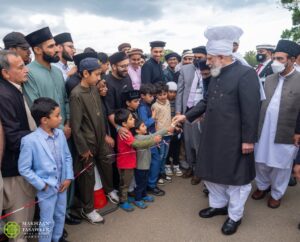
Jamia students would line up in the hope of catching Huzoor’s eye and quite often Huzoor would meet them, enquire after them and made those who seemed a little serious or stressed feel immediately at ease through a smile or light comment.
All in all, each week Huzoor would spend up to an hour greeting and meeting the many Ahmadis who had come to see him.
Guidance for a Troubled World: Wisdom, Warnings and the Way Forward
Throughout the year, various guests and dignitaries have come to Islamabad to meet Huzoor.
One such guest was Mr Reiner Braun, from Germany.
As an historian and peace activist, Mr Braun had spent decades confronting the threat of nuclear weapons and increasing warfare.
It was thus, inspired by Huzoor’s words and warnings about the fragile state of the world, that he came to seek Huzoor’s guidance on what could be done to secure its peace and security.
At the outset, Mr Braun mentioned that the current situation of the world’s peace and security was the worst he could recall in his life.
In response, Huzoor said:
“The reason that the world’s peace and security is breaking down is because the preferences of people have changed – they have become utterly selfish. This is seen across society, even many religious leaders, who are meant to guide mankind and be moral examples, have become selfish. Everyone wishes to fulfil their own desires at the expense of others. In such circumstances, peace cannot be achieved because peace requires ‘sacrifice’ rather than ‘selfishness’.”
Huzoor continued:
“So, until and unless nations and their people are willing to make sacrifices for the greater good and for others and until they inculcate a spirit of love and compassion for others, peace will not be achieved.”
The guest mentioned that geopolitical shifts were taking place in the world and that the United States and Western European nations were worried their power and dominance was being threatened by developing nations and the BRICS organisation.
In response, Huzoor said:
“Again, the core issue is ‘selfishness’. Instead of desiring for others what they desire for themselves, these (powerful) nations desire and need for themselves what they don’t desire or need for others. They are determined and desperate to maintain their supremacy… Most politicians are selfish and so, instead of seeking to bring people together and create harmony, they are exploiting nationalist sentiments and frustrations for their own political benefit. This is wrong and immoral.”
Speaking about Europe, Huzoor said:
“For Europe to maintain its strength and influence on the world, it must – as I said in a speech at the European Parliament several years ago – unite together. As individual countries, the power and influence of European nations is very limited – their strength lies in unity. So, as a German citizen, you should tell your people that it is necessary for European nations to cooperate and work together in all respects, whether in terms of their economies, currencies, their military and also at a political and social level. Otherwise, on their own, European countries will be weak and diminished.”
Huzoor said:
“For example, if the German Government on its own were to condemn the cruelties in Gaza it would have hardly any impact. However, if all European countries together condemned the Israeli Government policy it would have an impact. Even the coming together of just three nations – UK, France and Canada – to condemn Israel recently had some effect.”
The guest mentioned how he agreed with Huzoor’s views on Gaza and expressed his dissatisfaction that the German Government continues to sell weapons to the Israeli Government.
In response, Huzoor said:
“I believe that Germany sells weapons not only due to its close relations with Israel but also because the German economy has been struggling… Given this, you should try to persuade your people that profit is not everything. Ethics and morality are of far greater importance.”
Huzoor said:
“Recently, the German Chancellor (Friedrich Merz) stated that it is difficult for Germany to speak against the Israeli Government due to its history and what happened in the Second World War. However, I do not understand why the German people today consider themselves guilty for what happened generations ago. The Holocaust was not the fault of today’s German people, rather it was the fault of Hitler and the Nazis, who have all since died. Likewise, the fact that the Jews suffered great cruelties and persecution at that time does not give the Israelis a licence to kill and maim innocent countless Muslims today.”
The guest introduced his organisation – The International Peace Bureau (IPB) and its objectives to end war. He mentioned how it had won the Nobel Peace Prize in the early 1900s.
In response, Huzoor said:
“If you are successful in stopping wars in this era then your organisation will deserve another Nobel Prize! However, even the Nobel Prize now is now tainted by a degree of politics.”
The guest mentioned how his group’s objective was also to bring an end to nuclear weapons in the world.
In response, Huzoor said:
“Several years ago, I wrote to the leaders of many countries who have nuclear weapons to warn them of the risk of nuclear warfare and to urge them towards disarmament. Only the UK Prime Minister at the time gave a detailed response. Most others did not even bother to reply.”
Huzoor continued:
“What the nuclear powers should realise is that if they do not reduce or eliminate their stockpiles, it will only encourage and fortify the desire of other nations to also acquire nuclear weapons. The more weapons that exist and the more nations that possess them – the more chance of nuclear war.”
Thereafter, Huzoor said:
“The key thing which we must work towards is establishing true freedom – this includes freedom of religion, freedom of belief, freedom of conscience, freedom of speech and freedom to live in peace. All of these freedoms are intertwined and indispensable. So, you should never give up and I hope that many thousands of other people like you who strive for peace emerge.”
In reply, the guest said:
“Actually, it is not people like me who are needed it is people like you that the world needs! It is your message that needs to be heard and shared far and wide!”
Thereafter, the conversation returned to the conflict in Gaza and the plight of the Palestinians.
Huzoor said:
“At this time, the situation is so dire, that talk of a ‘2-state solution’ is irrelevant. At the very least, the Palestinians should be given some respite from the horrific and brutal attacks they are facing. They should be allowed to live in peace. They should be allowed to breathe. Let their children eat. Do not starve them. Yet, instead, we see that they are being starved and, if they wish for food, they are told to walk through the dead of the night for 6 hours and thereafter, upon reaching the aid stations, they are met not by food but by bullets. It is horrific.”
As Huzoor said these words, I felt Huzoor’s anger and despair at the double standards, hypocrisies, deception and brutalities being perpetrated by Israel and those nations who were facilitating the war in Gaza in any way.
Huzoor further stated:
“So, you should tell the German people to remove their complexes about Israel. Tell them it was Hitler and the Nazis who killed the Jews who perpetrated that genocide against them. Today, the Germans must learn from their past, rather than be paralysed by it. Do not be participants in another genocide (in Gaza) whereupon history will surely hold all those in contempt who have perpetrated it or are assisting in it.”
I loved Huzoor’s point about the Germans learning from their past, rather than being paralysed by it.
As the meeting concluded, Huzoor made it clear that when it came to the war in Gaza that his criticism was levelled at the Israeli government and authorities, not on members of the general public or Jewish people.
Emphasising this distinction, Huzoor said:
“In terms of our community, where we (Ahmadis) condemn what is happening in Gaza, we are not against the people of Israel. We are not against the Jews. Rather, we are against the policy of the Israeli Government towards the Palestinians.”
Cookies, Compassion & Confidence
In early July, on behalf of my wife, I approached Yasir Wasim sahib, a Khadim who manages the Islamabad ‘Tuck Shop’ about whether he would be interested in stocking a ‘cookie and cream’ dessert that she had developed.
After testing a sample, he agreed and gave an order of 15 individual portions for the Friday that followed. He said he would see if the desserts sold and what the feedback was. If it proved popular, he would give further orders in future.
Friday soon came and so Mala duly delivered the desserts to him. And after Jummah, our children and I were charged by Mala to go and see if they were selling!
They were indeed selling, though some were bought by Mahid and Moshahid themselves! My mother-in-law had just arrived from abroad as well and she also sent Mahid to buy a couple of desserts as well to help get the ball rolling!
Later in the day, as part of the Friday afternoon walk, Huzoor briefly visited the Tuck Shop and spent a few minutes inspecting the products being sold.
Afterwards, Yasir told me that he had informed Huzoor that one of the new products that day was Mala’s dessert. Huzoor enquired how much the pots were being sold for and what Mala’s profit margin was! This was something she had not yet had the courage to discuss or ask about!
It was a blessing for Mala to know that Huzoor was aware of her new venture and aware of the costings, though Mala was slightly worried if it was something Huzoor considered appropriate for her to continue with.
The next day, I reported for Mulaqat and presented a briefing as normal.
At the end, just as I was leaving, Huzoor smiled and said:
“Yesterday, I visited the Tuck Shop and Yasir showed me a cream pudding that he had new in stock and I thought he said that ‘Abid sahib has made it!’ So I asked him in surprise: ‘Did Abid make it?’ and then he said ‘Abid sahib’s wife’.”
Huzoor said he had enquired the cost of producing it and the cost of sale.
In reply, I mentioned that she had not discussed the details with Yasir because it had just been a test to see if any were sold.
Huzoor smiled and said:
“She will make a small profit if she keeps making them. Tell her that, during the Jalsa period, instead of 15, she should make 25 or 30 servings, because there will be a lot of rush and so she can earn a little bit more during these days.”
I thanked Huzoor and thought of how Huzoor so graciously supports Ahmadi women and encourages them to partake in small businesses or ventures, which do not cause them to neglect their family responsibilities.
Thus, where Mala was worried whether Huzoor may consider it appropriate, in fact, Huzoor encouraged her and gave her the confidence to continue something that might prove a means of support for her. When I told Mala she was relieved and delighted.
As I left, I also mentioned that even though Mala’s desserts had sold out, the truth was that Mahid and Moshahid had gone and bought several from their pocket money!
Very tenderly and kindly, Huzoor said:

That:
“The children are encouraging and supporting their mother.”
Faith & Freedom – Lajna Leads
In the last year, a debate surrounding a ban on ‘cousin marriage’ has gained significant attention in the UK. The issue had been raised by politicians, resulting in a draft Bill to ban it being presented to Parliament late in 2024 by a Member of Parliament.
The debate has been fuelled by commentators drawing attention to the perceived medical risks associated with such marriages. For example, Matthew Syed, a well-known and highly respected journalist and commentator, has advocated strongly in favour of the ban.
Though a ban was not imminent when the Bill was first presented in Parliament, I informed Huzoor about it.
Upon this, Huzoor said:
“Even if such a ban is unlikely in the near future, if the public or media pressure increases, it is quite possible that the Government will bow to it in the future. And when one thing is banned, they will feel emboldened to bring further restrictions on religion and especially on Islam. Thus, even though the majority of Ahmadis do not marry their cousin and so would not be affected we should not consider this to be inconsequential. We should publicly respond and Lajna should take the lead in this effort.”
Thereafter, Huzoor gave various points of guidance. At a broader level, Huzoor said such a ban would be against the principle of personal autonomy. Moreover, in terms of the medical arguments, Huzoor said that other factors such as drinking alcohol or smoking are known to have extremely adverse effects on unborn children, yet there is no discussion to legally proscribe them.
Huzoor also said that in Islam, all forms of ‘forced marriage’ were prohibited. Thus, if a person was not comfortable there was certainly no obligation whatsoever on marrying a cousin.
Additionally, the debate did not recognise that marriages within extended families were often a means of stability and support, which are crucial factors in the development of a healthy and happy child.
Following Huzoor’s guidance, several letters were published in national newspapers by Ahmadis. As per Huzoor’s direction Lajna Imaillah took the lead and were extremely successful in this campaign.
Thus, a few months later, during the summer period, a producer from BBC Radio 4 contacted Sadr Lajna UK, Dr Qurratul-Ain Rehman sahiba asking for a representative of Lajna to take part in a debate about proscribing cousin marriage on their programme ‘Across the Red Line’. The programme would require for the Lajna member to debate the issue with Matthew Syed.
Based on this invite, Sadr Lajna proposed Dr Maleeha Mansur sahiba, an Ahmadi doctor and also Lajna’s National Waqfat-e-Nau Secretary, to appear on the programme.
I was unsure if Huzoor would consider it appropriate for a Lajna member to appear on the programme to debate with a male journalist.
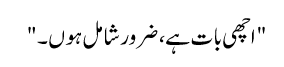
Yet, as soon as I mentioned it, Huzoor said:
That:
“It is a good thing and certainly they should take part.”
Huzoor noticed a slight degree of surprise on my face and asked me, with a smile:
“What is the harm?
In reply, I said:
“There is no harm at all. I was just a little unsure if Huzoor would deem it appropriate.”
I then mentioned that Sadr Lajna had proposed the name of Dr Maleeha Mansur sahiba.
In reply, Huzoor said:
“That is fine. She will be able to speak well and should certainly take part.”
Over the next couple of weeks, Dr Maleeha sahiba prepared for the debate and rehearsed the points of guidance Huzoor had given and researched empirical data and studies that supported our arguments and points of view.
Before the interview, I spoke with her to go through the questions and it was clear that she had thoroughly prepared.
At various times during the call, she said she would make a point during the debate, then her opponent would respond by asserting a particular point and then she would counter his argument by utilising a point of evidence or research in her favour. After this happened a few times, I asked:
“I get that you know what you are planning to say but how do you know what the other person is going to say?”
In reply, Maleeha sahiba stated that she had thoroughly researched all of Matthew Syed’s public interviews and articles. Consequently, she was confident that she could anticipate his response to every question and to her arguments.
I was very impressed and the next day, I mentioned this to Huzoor.
I said:
“Maleeha sahiba has researched the topic so much that she can anticipate what the other person will say and at what point. From this, I have learned that Lajna prepare better than our Press & Media team does!”
Hearing this, Huzoor smiled and his pride and satisfaction at the way highly educated Ahmadi women were taking a lead in the defence of their faith and beliefs was palpable.
The debate itself, which took place in mid-July went very well and the programme was broadcast a few weeks later. With the Grace of Allah, Maleeha sahiba spoke extremely well throughout and defended the principles of freedom of belief and freedom of religion in an exemplary fashion.
Undoubtedly, Huzoor’s guidance, encouragement and prayers enabled a representative of Lajna Imaillah to address a national audience with great authority about the dangers of curtailing religious and personal freedom.
From Anxiety to Assurance
One late afternoon during the summer months, I received an upsetting and distressing call. It was from an Ahmadi who did not at all appreciate a message I had sent them expressing my view that it had not been appropriate for them to repost a particular message on social media.
I had actually been instructed to contact the person by Huzoor, though, I did not mention this to them.
In their anger, the person made some comments that were quite personal. I tried a couple of times to respond but each time I spoke the person’s anger seemed to rise further and there was no opportunity for me to speak. Thus, after a few minutes, I hung up.
I had never received a call like this before and for the rest of the evening, I felt quite uneasy.
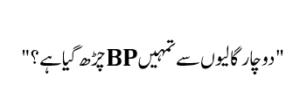
I actually felt as though my heart was racing a little. I assumed this was what people meant when they say in Urdu that ‘BP char gya hai’ – that their blood pressure had risen.
Over the next day, I continued to feel uneasy and thought about the conversation a few times.
I had sent a short note to Huzoor the night before explaining I had been involved in this heated conversation.
Thus, when I entered Huzoor’s office the next day, he mentioned it. However, he did not appear at all perturbed. In fact, much to my relief, Huzoor was smiling.
I said that, after the call, I had felt unwell and thought that my BP had been raised for a few hours.
In response, Huzoor smiled and said:
That:
“Just a few curses caused your BP to go up?”
I felt a little embarrassed thinking that my reaction had been an over-reaction.
Very calmly and reassuringly, Huzoor said:

That:
“This is normal and it happens… So what else have you brought?”
And with that the normal Daftari (official) Mulaqat routine resumed and nothing further was said about the matter that day.
I thought about what Huzoor had said and it occurred that to me that Huzoor has mentioned that he often, regrettably, receive letters from people abusing and cursing him. Furthermore, online there is so much hatred directed at him and Khilafat by the opponents of Ahmadiyyat. Yet, never do we see as much as a hint of anger, indignation or anxiety on his face as a result. Rather, Huzoor never rises to such provocation.
Having reassured me at a time of distress, the next day, Huzoor reviewed the actual message I had sent very carefully to ensure it was according to his direction.
I remember standing next to Huzoor as he read what I had written whilst praying that I had not misunderstood his instructions or written anything inappropriate.
After reviewing it, to my immense relief, Huzoor said there was nothing wrong with what I had written, though I had a tendency to be somewhat verbose in writing and the message could have been shorter. Huzoor said that the longer the message, the more chance there is of misunderstanding or conflict.
Thereafter, Huzoor said:
“If the person contacts you again to complain tell them that you sent the message on my instruction.”
Huzoor’s tone had suddenly shifted from a light tone to a firmer tone.
I felt such love for him that Huzoor sought to take my burden onto his own shoulders if the matter was raised again.
Friendship with Allah: Not One-Sided
One afternoon earlier this year, whilst in Mulaqat, I mentioned to Huzoor that when I meet young Ahmadis, sometimes they express that they do not feel as though they are deriving benefit from Salat.
Hearing this, Huzoor said:
“In the Holy Quran, Allah said to the Arabs who had newly accepted Islam that do not say that you have believed yet, rather say only that you have ‘accepted’ Islam because true belief has not yet entered your hearts. This illustrates that the standard of ‘faith’ (imaan) is far higher than simply reciting the Kalima.”
Huzoor said:
“Similarly, to merely pray in a superficial way or to offer the various postures of Salat quickly is not true prayer or worship. Such prayers do not confer real benefit. Rather, proper Salat is that which is offered in a state of complete submission to Allah and when a person is consumed by the love of His Master and opens his or her heart before Him.”
Huzoor further said:
“Proper Salat requires that a person expresses his love and gratitude to Allah the Almighty at all times and in all states, rather than only turning to Him when faced by a trial or when they desire something.”
Thereafter, Huzoor explained that many people are guilty of expecting Allah to save them from all forms of pain or hardship, yet they themselves do not fulfil the demands placed upon them.
Huzoor said:
“Recently, I received a letter from an Ahmadi who said that Allah says that He is the ‘friend’ of a believer and, if this is true, how can it be that Allah permits His friends to face trials or sorrows? In response, I wrote that true friendship cannot be one-way. It cannot be that we expect Allah to fulfil our every need and to save us from every trial, if we fail to adhere or listen to His commands. Nor can it be that we fail to remain patient and to keep our trust in Him if and when we face some form of distress.”
Continuing, Huzoor said:
“So, tell the Khuddam that there is no such thing as ‘one-way’ friendship – rather that is actually ‘selfishness’. As humans we must seek Allah’s true friendship by praying with sincerity, humility and devotion whilst seeking to fulfil all his commands. Then, we will certainly see Allah’s friendship towards us.”
A Summer Break & Back to Islamabad
In mid-August, with Huzoor’s permission, my family and I took a few days of holiday. We visited Wales and also enjoyed a day out in London.
The night before we went away, I reminded Huzoor of our plan and asked after how many days should I return to the office. I mentioned that in my formal application I had requested five days leave but that if Huzoor required it could be shortened.
Very graciously, Huzoor said:
“Take as long as you like.”
Upon this, I mentioned how the previous summer in 2024, I had requested some leave and Huzoor had instructed to come back within three days because he required some work from me in relation to the Germany Jalsa.
Hearing this, Huzoor said:
“This year is no such work. So you can take 5 days as you have requested. Or you can even take 10 days!”
I replied:
“Jazak’Allah, 5 days is more than sufficient for us.”
Thereafter, Huzoor enquired where we planned to visit in Wales.
I mentioned I had made a hotel booking in Cardiff for a couple of nights.
Upon this, Huzoor said:
“If you are going to Wales you should visit some of the scenic parts not just the city.”
If Huzoor had not said this, most likely, we would have just stayed in and around the city. Instead, we went on some extremely scenic drives deep into the Welsh valleys and countryside. We reached a part of the coastline where the view was captivating.
As we enjoyed the fresh air and exquisite natural beauty, I was so grateful and glad that Huzoor had encouraged us to go further afield than we otherwise had planned.
Upon returning to Islamabad, I was extremely glad to meet Huzoor and to narrate some incidents of our travel.
After telling him about visiting Wales and the blessings of following his advice, I also mentioned a day trip we took to London.
I mentioned how we had visited ‘Harrods’, the famous department store. Known for its luxury and high prices, I mentioned how, amongst the exorbitant prices and premium goods, there was a portion of smoked salmon that had been marked down to a relatively cheap price, as it had reached its ‘Use by’ date.
Having been purchased, the salmon remained unrefrigerated for several hours as we continued our day out.
The weather was hot and so when we returned home I wondered if it would be safe to eat or if it should be discarded. As it looked ok, I decided to take a bite. It tasted fine and so two of our children also eagerly ate some.
However, as soon as we had consumed it, I started feeling anxious and wondering if I had made a mistake in eating it. I was particularly regretful of having fed it to the children. I started looking up online the effects of eating salmon that had potentially gone off and soon came across some horror stories!
The next 24 hours proved to be an unpleasant waiting game, wondering if there would be any adverse effects.
I told Huzoor that I had prayed and done Istighfar and that, thankfully, with the Grace of God, we were all fine.
Hearing this, Huzoor mentioned a native, herbal remedy which helped alleviate stomach complaints or sickness and said we should keep that in our home.
Thereafter, I mentioned to Huzoor that in Harrods we saw that they were selling grapes at a cost of £75 per bunch!
Apparently, the grapes were imported specially from Japan but they looked quite ordinary to us.
Hearing this, Huzoor said:
“Harrods fleece customers! It is just the ‘name’, otherwise the quality is not that high. In the past, I received some fruits and cakes from Harrods as a gift and the fruit was over-ripe and the cakes were also not very good. On the other hand, I have found that the food quality of Marks & Spencer is much better.”
Joy in duty – Unwell but Unwavering
A few days later, on 19 August, I entered Huzoor’s office for Mulaqat and could immediately see that he was not feeling well.
Indeed, as soon as I entered, Huzoor said:
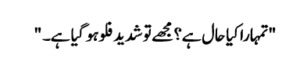
That:
“How are you? I have a severe bout of flu.”
Huzoor said he was taking a combination of western medicines, homeopathy and some herbal remedies in order to alleviate the symptoms so he could continue working.
He said it was his intention to start preparing his addresses for the Germany Jalsa that day but that he was now unsure if he would be able to prepare.
Huzoor said:

That:
“A person makes his own plan but sometimes Allah’s Will is different.”
Given that he was not well, I asked Huzoor if he would not take some rest at home, instead of remaining in his office.
In response, Huzoor simply said:
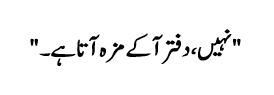
That:
“No, I enjoy being in the office.”
It was indicative of what I had always seen and known – that Khalifa-Waqt’s enjoyment is not in leisure or rest.
Rather, his joy and contentment lies always in the service of Islam and the mission of the Promised Messiah (as).
Huzoor smiled and said that he had actually been unwell for three days before but no one had noticed because he had concealed it and continued as normal.
Thankfully, with the Grace of Allah, within a day or two, Huzoor was fully recovered and well.
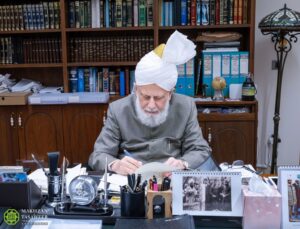
From Correction to Kindness
One afternoon, I presented a report about the day’s news events to Huzoor.
Whilst mentioning a particular world leader, I used the respectful Urdu form of address, ‘unhon ne’ “انہوں نے“ to describe him.
This form of respect was something that Huzoor picked upon and did not appreciate.
Huzoor said:
“When you refer to him you use the polite and respectful form of address. Such a person who is responsible for the murder and torture of countless innocent people deserves no such respect.”
I felt deeply embarrassed.
Even more so when Huzoor added:
“I have waited for many months hearing you describe that person with such respect but today, I finally thought I should point it out to you.”
I knew Huzoor’s admonition stemmed from his extreme grief and pain at the suffering of innocent people at the hand of the world leader I had mentioned.
I apologised and, still slightly flustered, resumed the report. Thereafter, a silent debate took place in my mind every time I was about to mention a world leader assessing whether they deserved a respectful form of address or not.
I think, for the rest of the Mulaqat, I played it safe and addressed all leaders or politicians in the less respectful manner.
I then mentioned a news report in which one government had alleged foreign agents of inciting division in their country. The Urdu word I used to describe ‘division’ was ‘tafrika’.
Upon this, Huzoor said:
“Some very experienced Urdu speakers do not use the word ‘tafrika’ correctly and mispronounce it. But you use it and pronounce it correctly, Mashallah’.”
Undoubtedly this was Huzoor’s kindness and love – that a moment or two before he had expressed his displeasure at the Urdu form of address and, having done so, he then made me feel almost instantly better by praising my use of Urdu in a different context.
In reply I said:
“Jazakallah, Huzoor. In fact, I have heard Huzoor use the word ‘tafrika’ and so it is because of Huzoor’s training that I learned this word and its use.”
Genocide or Not?
Regarding the ongoing cruelties and barbarity in Gaza, in recent months, Jamaat officials had contacted me asking if the Jamaat would officially declare what is happening to be a ‘genocide’ or ‘ethnic cleansing’.
In late August, upon a request of an official from US Jamaat, I sought Huzoor’s guidance in this regard.
In reply, Huzoor stated:
“If our Jamaat is asked for its opinion about whether a genocide or ethnic cleansing is being committed we can and should reference the numerous organisations, agencies or experts who say that it has reached the threshold of genocide or that ethnic cleansing is being committed. However, in our own statements, we should continue to express our grief and strongest possible condemnation at the mass killings and massacre being perpetrated by Israel.”
Explaining this point, Huzoor said:
“We stand up for the rights of the deprived, persecuted and feel the pain of those who are suffering but there is no need or benefit for us to seek to make political or legal determinations.”
Huzoor’s guidance was profound. Due to the emotion attached to what is happening in Gaza, some may feel a desire for the Jamaat to label it as a genocide. However, Huzoor’s guidance was that if we start making legal determinations it could ultimately prove a means of taking us away from who and what we are – a spiritual and religious community.
Further, if the Jamaat were to start making such pronouncements where would one draw the line?
Would we then start assessing every conflict to see if it met a threshold for genocide or ethnic cleansing?
Instead, as a spiritual and religious organisation, from the very first day of the conflict, Huzoor has guided Ahmadis that it is our duty to pray for the victims and to seek to help them practically in whatever way is possible and according to our means and abilities.
A Message Prepared
Though the Germany Jamaat had hoped that Huzoor may grace this year’s Jalsa Salana Germany in person, as the Jalsa grew closer, many realised it was unlikely. It was not like last year when it was expected that Huzoor would travel to Germany.
I recall that period in early August 2024 with sadness. Though the UK Jalsa Salana had taken place very successfully, it became apparent in the days that followed that Huzoor was not in the best of health.
Rarely before had I heard Huzoor express any worries or concerns about his health. Even in the days prior to Huzoor’s heart procedure, Huzoor remained always in good spirits. But, in the lead up to the Germany Jalsa 2024, Huzoor mentioned to me several times that he was not feeling well and it was apparent that he had some apprehensions regarding the travel.
I would respond by saying that, for the entire Jamaat, Huzoor’s health was a priority and so Huzoor should only travel if he felt well enough. I sensed that where Huzoor was inclined not to travel, he also did not wish to cause any distress or pain to the members of the Germany Jamaat. I believe it was for this reason that Huzoor held back his final decision to cancel his visit in 2024 to the last possible moment.
In fact, Huzoor continued his preparation for the German Jalsa in 2024 as normal.
Thus, a few days before the tour was due to commence, Huzoor called me to his office and dictated an address which he was due to deliver in English to non-Ahmadi and non-Muslim guests at the Germany Jalsa.
The address was fully prepared but, in the end, was not delivered. And when I look back at the words Huzoor dictated over a year ago, they seem even more apt and applicable today.
Whilst giving dictation, Huzoor said:
“Across Europe and much of the Western world, a belief has taken root that Islam and Muslims are the cause of much of the division, conflict and instability in society. In particular, there is a growing view that immigration, particularly from Muslim countries, is a direct threat to the peace and prosperity of the Western world. It is increasingly argued that strong measures must be taken to stop foreigners coming to the West or to restrict the religious practices of Muslims.”
Huzoor spoke of how it was an “irreversible reality” that the world was a much smaller place due to the unprecedented speed of modern communication.
Consequently, it was not possible or desirable for nations to isolate themselves and banning all forms of immigration was neither practical nor wise, as it would harm productivity and economic growth.
Continuing, Huzoor said:
“The presence of immigrants or people of different religions need not destabilise a nation or ignite fear amongst society. In fact, their presence should strengthen a nation’s foundations. The key point is that irrespective of one’s religious or ethnic background, all citizens and residents of a nation must sincerely strive for their country’s peace, harmony and success.”
Very poignantly, addressing those who fear Muslims, Huzoor further said:
“Under no circumstances does Islam permit Muslims to cause disorder in society or give any licence to kill or injure those who do not accept its teachings… Rather, our Gracious God only desires for Muslims to capture and captivate the hearts of mankind through love, sympathy and compassion. Islam did not enter this world to cause death or destruction. Islam came to heal, not to harm. Islam came to unite, not divide. Islam came to give life, not to extinguish it.”
A few days later, the Germany Jamaat were informed that Huzoor would not travel to Germany. Unquestionably, it came as a shock to them. Yet, they remained very fortunate that Huzoor addressed their Jalsa live via MTA.
Unceasing Service: The Devotion of Khilafat
Similarly, this year, Huzoor again addressed the Jalsa Salana Germany live from Islamabad on consecutive days.
With the Grace of Allah, as Huzoor delivered a faith-inspiring concluding address, my overriding emotion was of happiness and relief that Huzoor’s health was much improved from a year before.
After delivering the concluding address on 31 August, Huzoor departed from the Masroor Hall in Islamabad at 5.10pm and returned to his residence.
Given Huzoor had just delivered the concluding address, I thought he would take some time to rest before returning to his office.
Indeed, I thought it unlikely that Huzoor would return to his office before 6pm and so I was somewhat relaxed thinking I had some time before I ought to report for Mulaqat. However, just as I was thinking this, it occurred to me that I should not risk being late and so I went to the Private Secretary’s office at 5.20pm.
Within a minute of my reaching, Huzoor came to his office and called me. Instead of taking any personal time or rest, Huzoor had returned swiftly to his office.
Often after such addresses or events, if I have the chance to meet Huzoor, he enquires if everything went ok.
So, it was on this occasion as well.
Huzoor asked:
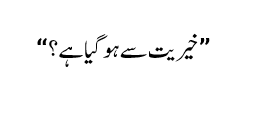
That:
“Did everything go ok?”
In reply, I said that everything was well and that, above all, I was grateful that, in contrast to a year before when Huzoor was in a state of unease, this year Huzoor seemed well.
Huzoor (aba) did not comment but gave a hint of a smile.
Thereafter, I added:
“Now, after the conclusion of the UK and Germany Jalsas, perhaps Huzoor may have some time to rest.”
In reply, Huzoor said:

That:
“In a couple of weeks, the Ijtemas of Lajna, Ansar and Khuddam will take place.”
Hearing this, I said:
“Well hopefully Huzoor may find some time to rest in October then.”
I made this comment without thinking and it came out somewhat involuntarily!
I felt afterwards it would have been better for me to remain quiet at that point but thankfully Huzoor did not seem to mind.
In reply, Huzoor (aba) stated:
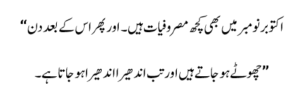
That:
“In October and November, there are also some engagements. Thereafter, the days will shorten and the nights shall be long.”
Hearing this, I said:
“Huzoor, the truth is, and we have all witnessed this, that your work continues relentlessly in every month and season.”
Huzoor smiled and then indicated that I should take leave and before I had reached the door to leave, he had resumed his work.
Conclusion
In this account, I have sought to highlight the immense blessings of Khilafat. It is a topic that no one can ever do true justice to. At every moment, Hazrat Khalifatul Masih V (aba) continues to serve the mission of the Promised Messiah (as) with wisdom, grace, and profound humility. Every word, every gesture, and every prayer of Huzoor is devoted to bringing people closer to God Almighty and fulfilling the rights of His creation. Though the past few years have brought trials, the blessings associated with Khilafat have continued to ever increase. Alhamdulillah.
May Allah the Almighty grant Hazrat Khalifatul Masih V (aba) a long, healthy and active life in all respects. Ameen.