Khuddam From USA’s Virginia Region Have Honour of a Meeting With Head of the Ahmadiyya Muslim Community
“It should not be that one standard applies to one person and another to someone else. Equality must prevail everywhere, and that is what Allah desires and what we must do.” – Hazrat Mirza Masroor Ahmad
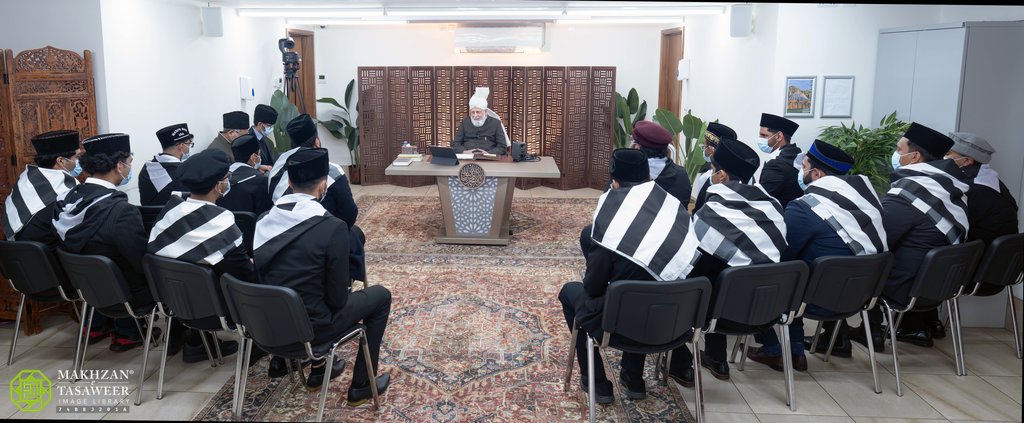
On 29 December 2025, the World Head of the Ahmadiyya Muslim Community, the Fifth Khalifa (Caliph), His Holiness, Hazrat Mirza Masroor Ahmad held a meeting with a delegation of 16 members of Majlis Khuddam-ul-Ahmadiyya (Ahmadiyya Muslim Youth Association) from USA’s Virginia Region.
His Holiness presided the meeting from MTA Studios in Islamabad, Tilford.
Upon his arrival in the studio, His Holiness greeted the delegation. Each attendee was then granted the opportunity to introduce themselves. Throughout the meeting, members had the opportunity to seek the guidance and counsel of His Holiness on a broad range of matters.
Following this, attendees had the opportunity to seek guidance from His Holiness on various matters. One attendee sought guidance from His Holiness regarding how one can balance honouring one’s parents’ wishes with making independent decisions in matters of faith and worldly affairs.
Hazrat Mirza Masroor Ahmad stated:
“In the Holy Quran, Allah the Almighty commands us to respect our parents. Even if they reprimand you, you should endure it and do not talk back to them. Some people speak very harshly to their parents, but Allah the Almighty prohibits this, except in cases where parents prevent one from religious matters or forbid adherence to the Shari‘ah. In such matters, one should not obey them, yet even then there is no need to argue or talk harshly. This is because parents endure many hardships – especially the mother, who gives birth, then nourishes and raises the child. Parents provide financial support and teach their children how to read and write. Thus, they have bestowed many favours upon you. Therefore, one should seek to repay these favours by being grateful in accordance with the commandments of Allah the Almighty and by showing parents respect.”
Hazrat Mirza Masroor Ahmad continued:
“As for the question of ‘independence’, one should reflect on what independence is being sought in. If it relates to education, then one has the right to pursue the field of study one is passionate about. Regarding marriage, if a proposal comes in, one should first pray and then decide. In this matter, one is allowed to decide freely and independently but should explain the decision to one’s parents politely. While remaining within the bounds of Islamic teachings, a person is permitted to act according to their wishes but must always respond to their parents with respect and kindness and should never be quarrelsome.”
Another attendee explained that the demands of university studies make it challenging to find time to read Islamic literature and publications of the Ahmadiyya Muslim Community and sought guidance from His Holiness on how best to manage this.
His Holiness explained the importance of using the hours of the day effectively. His Holiness emphasised that one should endeavour to dedicate time after the morning prayer to the daily reading and recitation of at least three to four rukū‘ (sections) of the Holy Qur’an. Additionally, he advised incorporating the reading of literature of the Ahmadiyya Muslim Community before retiring for the night, whether from the books of the Promised Messiah (peace be upon him), collections of Hadith (sayings of the Holy Prophet Muhammad, peace and blessings of Allah be upon him), or commentaries of the Holy Qur’an.
One attendee expressed an interest in history and asked His Holiness how this could be used in service of the Ahmadiyya Muslim Community.
His Holiness explained that a strong understanding of history can be a valuable means of serving the Ahmadiyya Muslim Community. He encouraged the study of Islamic history and engagement with fields such as archaeology, noting that history is itself a deeply enriching subject through which one comes to understand the past, the advent of Islam, and the lives of Muslim historians, kings and conquerors and leaders. A sound knowledge of history, His Holiness said, enables a person to serve the Community more effectively. Alongside this, His Holiness advised learning about the history of the Ahmadiyya Muslim Community itself, adding that while not all volumes of Tārīkh-e-Ahmadiyyat (History of Ahmadiyya) have yet been translated into English, some are already available.
Following this, an attendee shared that he is the grandson of Maulana Attaullah Kaleem, a pioneering missionary and scholar of the Ahmadiyya Muslim Community and asked His Holiness how he could follow in his footsteps and become a devoted servant of the Community.
Hazrat Mirza Masroor Ahmad stated:
“He would regularly offer the Tahajjud prayer (the voluntary pre-dawn prayer) and pray for the progress of the Ahmadiyya Muslim Community, for others, and for his work. Therefore, one must have firm belief. Since you believe in Allah the Almighty, you should pray to Him to make you pious and enable you to become a good servant of the Ahmadiyya Muslim Community. Alongside this, you must be sincere and place complete trust in Allah the Almighty – this was one of his defining qualities.”
Hazrat Mirza Masroor Ahmad continued:
“Secondly, although financial conditions were extremely difficult during his time in Ghana, as the country was undergoing economic decline, he never complained and always spoke with a smile. He placed great trust in Allah, and Allah, in turn, bestowed His blessings upon him. In essence, one should have faith in Allah, observe one’s prayers, engage in supplication, and remain determined in pursuing one’s aims. If you possess these qualities and act accordingly, you will be able to manage all matters.”
A regional lead of the Waqar-e-Amal (Dignity of Labour) department sought guidance from His Holiness on how the spirit of labour could be instilled among members of the Ahmadiyya Muslim Youth Association. His Holiness explained that the English title “Dignity of Labour” had been deliberately adopted for this department precisely to cultivate a sense of honour and respect for work among the Khuddam.
Hazrat Mirza Masroor Ahmad stated:
“You should explain to the Khuddam that there is dignity in this work. No one paid greater attention to cleanliness and hygiene than the Holy Prophet Muhammad (peace and blessings of Allah be upon him), yet whenever the opportunity arose, he would personally engage in labour. There is an incident from the the Battle of Uhud where Muslims were digging trenches and the Holy Prophet (peace and blessings of Allah be upon him) himself dug and lifted rocks, becoming covered in soil and dust, to the extent that when he removed his overgarments, his abdomen and head were both smeared with dirt.”
Hazrat Mirza Masroor Ahmad continued:
“Therefore, tell the Khuddam: if the Holy Prophet (peace and blessings of Allah be upon him) participated in such labour, then who are we to refrain? We too should take part and make a concerted effort in this regard. As Muslims, we must strive to follow the example of the Holy Prophet (peace and blessings of Allah be upon him). It is through such acts that one earns respect. By serving the community, one is first rewarded by Allah, and secondly, the exertion also brings physical benefits, as it is good for your health.”
An attendee subsequently sought guidance from His Holiness for those aspiring to become doctors, asking how they could maintain and strengthen their relationship with Allah the Almighty while pursuing this profession.
His Holiness cited examples of several individuals within the Ahmadiyya Muslim Community who had achieved success as doctors while prioritising their prayers above all else, observing voluntary prayers, and actively contributing to the propagation of Islam. His Holiness added that simply by observing their sincere conduct, people had been guided to join the Ahmadiyya Muslim Community. His Holiness emphasised the importance of treating patients with kindness and helping the poor and needy in order to become “a good doctor, a good preacher of the faith, and a good Ahmadi Muslim.”
Hazrat Mirza Masroor Ahmad stated:
“A doctor should be very polite and humble, and take special care of the poor. In doing so, you are able to engage in Tabligh (propagating the message of Islam through your conduct), a form of ‘silent Tabligh.’ Allah the Almighty is pleased by this. [As a doctor], by serving the needy and the community, you not only please God Almighty and His people, but are also able to earn a livelihood.”
Nearing the end of the meeting with His Holiness, one attendee asked how we can raise our voice against political injustice and advocate for human rights.
His Holiness explained that one should seek to highlight such injustice to the best of their ability wherever possible. He shared an incident from when he spoke at Capitol Hill, where an American lawmaker present told him that the points His Holiness had raised were important and needed, but could not be acted upon due to political constraints, and ultimately vested interests. His Holiness also highlighted that lobbying efforts exist, where influential groups use wealth and power to impart pressure on those with influence to speak in their favour, making it difficult for true justice to be upheld.
Hazrat Mirza Masroor Ahmad further stated that:
“Allah the Almighty commands ‘absolute justice’. Only when complete justice is upheld can people establish fairness in the world. And refrain from seeking revenge; it should not be that one standard applies to one person and another to someone else. Equality must prevail everywhere, and that is what Allah desires and what we must do. And to the extent possible in your own environment, in your surroundings and the company you keep, do as much as you can”.
Before concluding the session, His Holiness reiterated the importance of setting and leading by one’s own example. He noted that many people write to him saying they accepted Islam after observing the conduct of Ahmadi Muslims, and only then engaged with the literature, which strengthened their faith. Others meet His Holiness, listen to his addresses, and subsequently pledge allegiance to the Ahmadiyya Muslim faith. Thus, His Holiness emphasised: “We should lead by the true example of what Islam stands for and teaches.”