130th Jalsa Salana Qadian Ends With Address by Hazrat Mirza Masroor Ahmad Who Urges the Community to Tread the Path of Righteousness and Adopt Compassion for All of Mankind
“Every Ahmadi across the world who is listening to me at this moment must always remember that we must make every possible effort for our spiritual progress and for fulfilling the pledge of allegiance.” – HAZRAT MIRZA MASROOR AHMAD
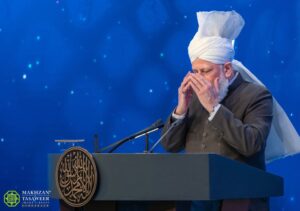
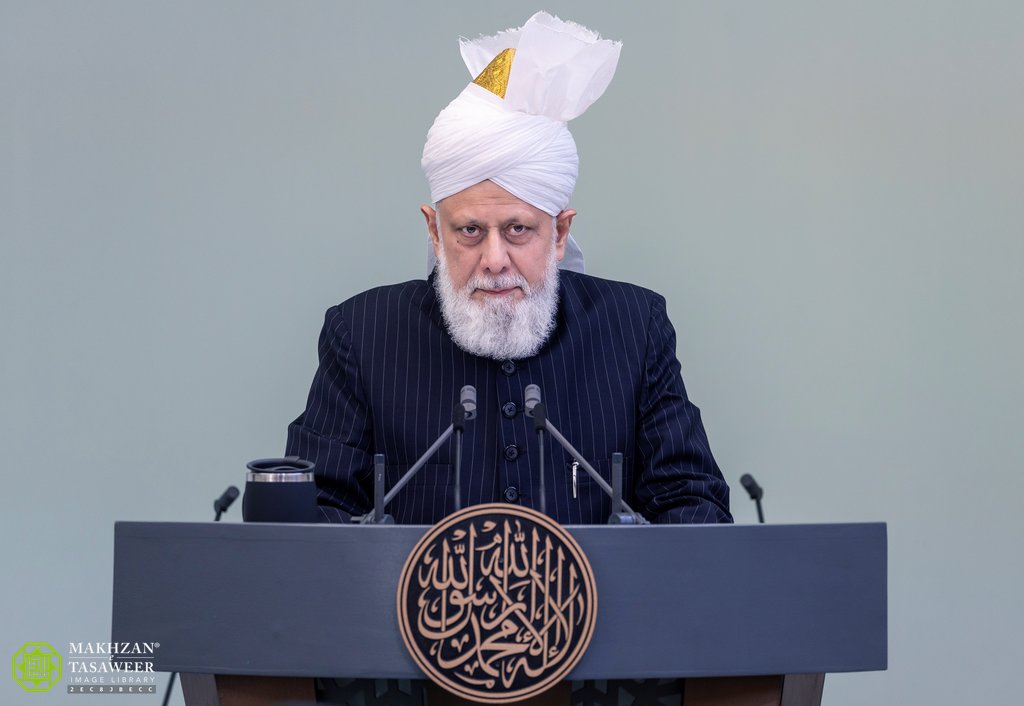
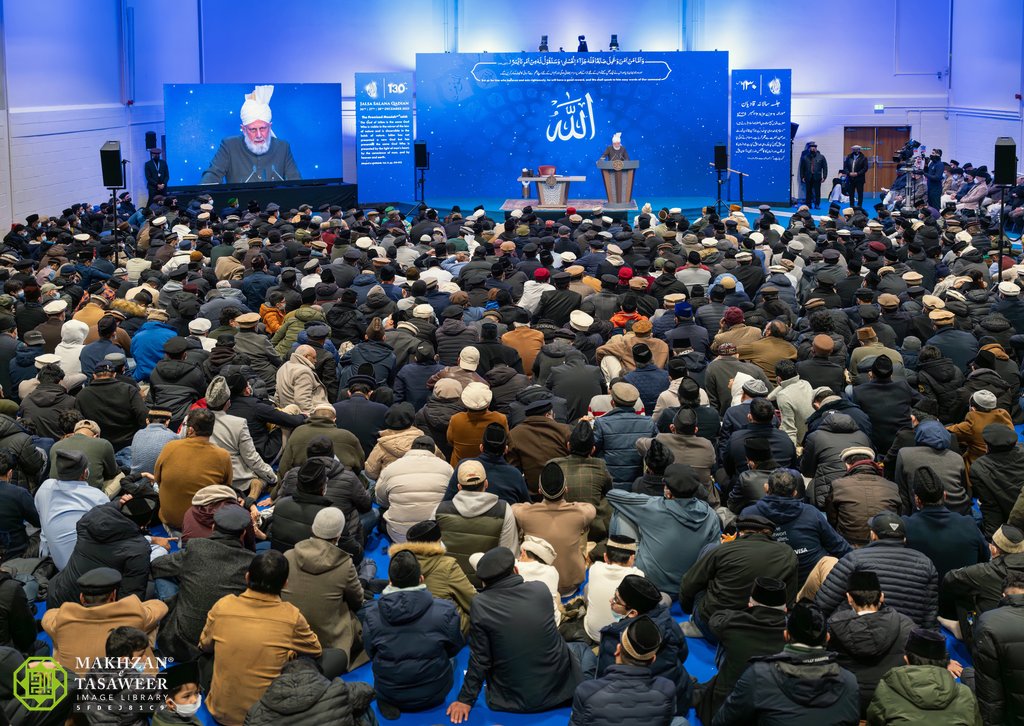
On 28 December 2025, the Worldwide Head of the Ahmadiyya Muslim Community, His Holiness Hazrat Mirza Masroor Ahmad, the Fifth Khalifa (Caliph), delivered the concluding address of the 130th Annual Convention (Jalsa Salana) of the Ahmadiyya Muslim Community in Qadian, India.
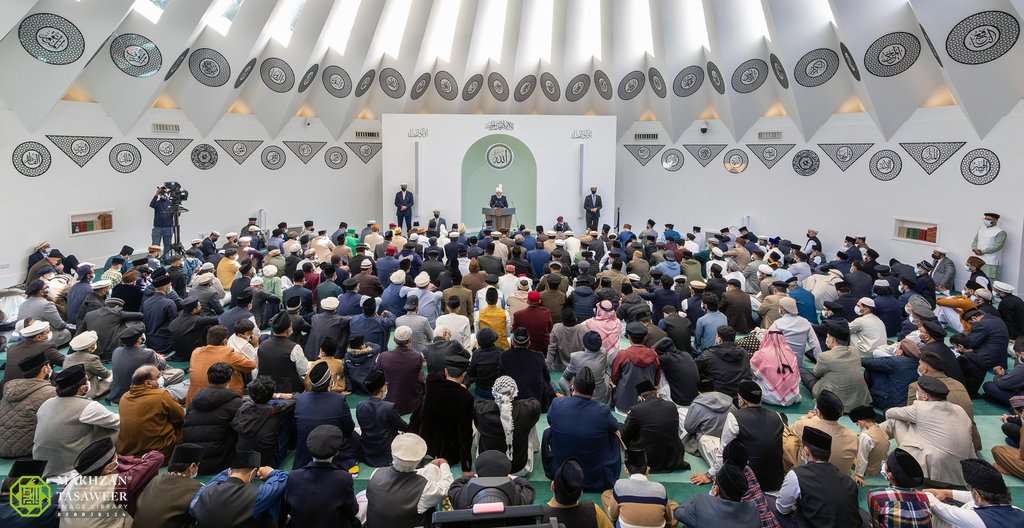
His Holiness presided over the concluding session from Masroor Hall in Islamabad, Tilford, while more than thirteen thousand participants gathered at the Jalsa site in Qadian, India. At the same time, over three thousand three hundred attendees assembled in Islamabad, Tilford, UK, to join the proceedings.

In addition, His Holiness announced that Ahmadi Muslims in several other countries, including Niger, Burkina Faso, Senegal, French Guiana, the Czech Republic, Guinea-Bissau, Togo, Congo-Kinshasa, and Germany, had organised collective gatherings to participate in the concluding session. He also noted that some of these countries were simultaneously holding their own Annual Jalsa Salana conventions, which reflected the truly global reach of the event.
During his address, His Holiness spoke about the true purpose of the Jalsa Salana, the responsibilities attached to the bai‘at (pledge of allegiance), and the urgent need for true righteousness within the Community.
At the outset, His Holiness noted that Jalsa Salana Qadian had reached its conclusion and recalled the words of the Founder of the Ahmadiyya Muslim Community, Hazrat Mirza Ghulam Ahmad, the Promised Messiah (peace be upon him), who described this gathering as one founded upon the support of truth and the exaltation of Islam, and not an ordinary convention.
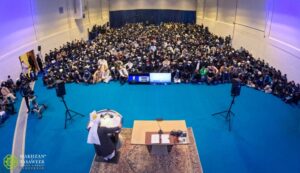
His Holiness highlighted how the fulfilment of this prophecy is now visible worldwide, as people from diverse nations and backgrounds participate in Jalsas across the globe. He noted that Qadian, once an unknown town, had now become a focal point for international gatherings, with representation from dozens of countries.
Hazrat Mirza Masroor Ahmad said:
“Today, we are witnessing the fulfilment of this statement of the Promised Messiah (peace be upon him), as Jalsas are being held in every part of the world and, just as he foretold, nations are joining them. The town of Qadian, which was once unknown, now sees people and nations from many countries participating in this Jalsa. According to the information available at present, there is representation from thirty-seven countries.”
His Holiness continued:
“Thus, this is clear and manifest evidence that this Jalsa enjoys the special support of Allah the Almighty. However, alongside this, we must also remember that only those people will benefit from its blessings who remain steadfast to the pledge of allegiance they made to the Promised Messiah (peace be upon him). Those who do not pay attention to their spiritual and moral improvement and progress cannot benefit from its blessings.”
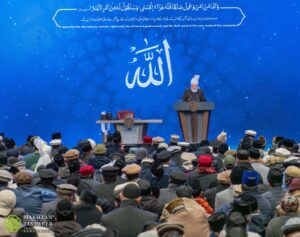
A central theme of the address was the true meaning and conditions of bai‘at (the pledge of allegiance). His Holiness explained that the bai‘at is not a ceremonial act, but a lifelong covenant requiring the abandonment of all forms of shirk (idolatry), including hidden and subtle forms such as reliance on one’s ego, wealth, power, or worldly strategies in place of God.
His Holiness explained the true meaning of shirk as defined by the Promised Messiah (peace be upon him). Quoting the Promised Messiah (peace be upon him), Hazrat Mirza Masroor Ahmad said:
“Remember that the true tawhid [belief in the Oneness of God Almighty], the affirmation of which God demands from us and upon which salvation depends, is to regard Allah as free from every partner – whether an idol, a human being, the sun or the moon, one’s own self, or one’s plans, schemes, and deceptions – and to consider none as possessing power alongside Him. That is, to always bear in mind that no one has power over Him. Only Allah the Almighty has the power to carry out my every task, to bring it to completion, and to produce good outcomes from it; therefore, it is before Him alone that I must bow.”
His Holiness explained that in the modern age, a wide range of moral challenges have become increasingly prevalent, and safeguarding oneself from these requires discipline and restraint. He said that those who enter into the pledge of allegiance commit themselves to truthfulness in all circumstances and to maintaining moral purity, not only in their actions but also in their thoughts and conduct.

His Holiness noted that contemporary media and emerging technologies frequently expose individuals to content that, even if it does not lead directly to wrongdoing, can cultivate harmful thoughts and weaken one’s moral boundaries. He emphasised that avoiding such influences and guarding one’s gaze and thoughts is an essential part of our faith.
He further explained that fulfilling the true spirit of the bai‘at (pledge of allegiance) requires abstaining from all forms of immorality, obscenity, injustice, dishonesty, disorder, and rebellion. Individuals must not allow themselves to be dominated by their worldly desires, but instead exercise self-control. His Holiness noted that by protecting oneself from such influences can one truly fulfil the responsibilities associated with their pledge of allegiance.
Thereafter, Hazrat Mirza Masroor Ahmad spoke about the Promised Messiah’s (peace be upon him) emphasis on the importance of the five daily prayers.
His Holiness stated:
“The Promised Messiah (peace be upon him) stated that those who have pledged themselves to me in allegiance must offer the five daily prayers and must also strive to observe the Tahajjud prayer (the voluntary pre-dawn prayer). They must send blessings upon the Noble Prophet (peace and blessings of Allah be upon him), continually seek forgiveness for their sins, and adopt regularity in reciting Istighfar (the prayer for seeking forgiveness from Allah the Almighty). They must remember the favours of Allah the Almighty from the depths of their hearts and make His praise their daily practice.”
Addressing a question often raised about how one develops closeness to Allah the Almighty, His Holiness explained that this relationship is cultivated through remembrance and gratitude to Allah. His Holiness said that the pledge of allegiance itself lays out a clear path, requiring individuals to continually remember the favours of Allah and to make His praise a regular part of their lives. His Holiness explained:
“When you praise Him and remember His favours, closeness to Allah the Almighty is attained automatically.”
His Holiness then said that those who have entered into this covenant must never cause unjust harm to the creation of Allah, whether through words, actions, or any other means, and that this obligation applies broadly to all people and especially to fellow Muslims.
His Holiness further explained that true allegiance requires unwavering loyalty to Allah in all circumstances. Whether faced with ease or hardship, a believer must remain steadfast and content with the will of Allah the Almighty.
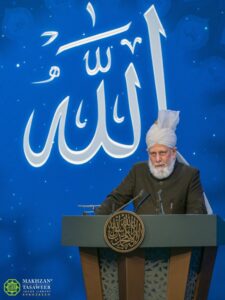
Hazrat Mirza Masroor Ahmad said:
“We must be prepared to endure every hardship in the way of Allah the Almighty, and in times of difficulty or trial, we must never turn away from Him… there is no refuge for us other than Allah the Almighty. We must bow only before Him, and when we continue to bow before Him and steadfastly fulfil the right of His worship, Allah the Almighty will, in turn, bestow His grace.”
His Holiness then explained that the followers of the Promised Messiah (peace be upon him) have also pledged to rid themselves of spiritual ailments such as arrogance and pride.
Hazrat Mirza Masroor Ahmad said:
“If you have entered into the allegiance of the Promised Messiah (peace be upon him), you must also abandon certain [spiritual] ailments -namely, you must never harbour arrogance. Abandon the disease of arrogance entirely. Forsake pride and instead adopt virtues such as humility, meekness, and good moral conduct. You must pledge to live a life marked by gentleness and simplicity. Only then can you become true Ahmadis. Thus, we must keep this matter before us and continually assess the extent to which these qualities exist within us.”
Following this, His Holiness explained that entering into the pledge of allegiance requires placing faith and the honour of religion above all personal interests. He emphasised that true allegiance demands full devotion to seeking the pleasure of Allah the Almighty and a willingness to make sacrifices when required. His Holiness reminded the Community that while this pledge is renewed on many occasions, its true value lies not in verbal repetition but in consistently keeping it at the forefront of one’s life and striving to live by it in practice.
Hazrat Mirza Masroor Ahmad further explained that compassion for the creation of Allah is an essential part of faith, and that such compassion must be motivated purely by the desire to please Allah.
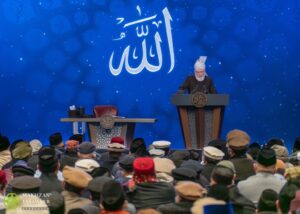
His Holiness stated:
“You can only fulfil the true right of the allegiance to the Promised Messiah (peace be upon him) when you possess compassion for the creation of Allah the Almighty, and that this compassion must be solely for the sake of Allah. To the extent possible, and using the strengths and blessings Allah the Almighty has bestowed upon you, you must endeavour to benefit mankind. This includes financial sacrifice, the sacrifice of time, and other forms of assistance. Thus, in whatever manner a person is able to help others and serve the creation of Allah, they should do so.”
After this, His Holiness stated that the true fulfilment of the pledge of allegiance is only possible through complete obedience and loyalty to the Promised Messiah (peace be upon him). Hazrat Mirza Masroor Ahmad explained that this obedience must be practical and reflected in one’s conduct and commitment to the teachings and objectives for which the Promised Messiah (peace be upon him) was raised.
With regards to the mission of the Promised Messiah (peace be upon him) and the objectives for which he was sent to this world, Hazrat Mirza Masroor Ahmad said:
“The Promised Messiah (peace be upon him) came into this world for the purpose of removing the dust that had settled upon the teachings of Islam due to the passage of time and the actions of misguided people, and of presenting Islam once again before the world in its pure and radiant form. His mission was to present the original religion brought by the Holy Prophet (peace and blessings of Allah be upon him) before people, to encourage practical adherence to it, and to prepare a Community for this purpose.”
His Holiness continued:
“Thus, these were the objectives for which he was sent. He stated that only when your condition becomes such that you obey me in every respect, and no worldly relationship, attachment, or state of servitude becomes an obstacle in this bond, will you be able to fulfil the right of the pledge of allegiance.”

His Holiness urged every individual to engage in sincere self-reflection and assess the extent to which they are acting upon these teachings in their daily lives. His Holiness explained that while the pledge of allegiance and participation in Jalsas provide valuable opportunities for spiritual advancement, their true purpose lies in creating an environment of worship. Through the institution of the Jalsa, established by the Promised Messiah (peace be upon him), a spiritual atmosphere has been created that reconnects people with Allah the Almighty.
Hazrat Mirza Masroor Ahmad stated:
“Therefore, every Ahmadi across the world who is listening to me at this moment must always remember that we must make every possible effort for our spiritual progress and for fulfilling the pledge of allegiance. We must keep these matters constantly before us, strive to act upon them to the fullest extent possible, and never distance ourselves from them.”
His Holiness highlighted that, according to the Promised Messiah (peace be upon him), there is one quality that surpasses all others in importance, and that is taqwa (righteousness). Whilst quoting the words of the Promised Messiah (peace be upon him), Hazrat Mirza Masroor Ahmad said:
“Mere words are of no benefit without action. If you wish to serve Islam, if you wish to fulfil the right of your pledge of allegiance, then you must first adopt taqwa and purity within yourselves. When you do so, you will enter the strong fortress of Allah the Almighty’s protection – such a mighty citadel that no harm will be able to reach you.”
His Holiness continued:
“At another place, The Promised Messiah (peace be upon him) stated that taqwa alone is such a quality that it may be called the essence of the Shariah (the law of Islam). If one wishes to describe the Shariah concisely, the very core of the Shariah is taqwa. Therefore, this is a fundamental matter which we must always remember. Only if there is taqwa can we say that our being Muslims and our being Ahmadis can truly benefit us; otherwise, it cannot.”
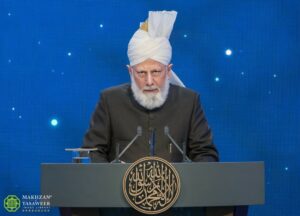
His Holiness explained that the acceptance of prayer is inseparably linked to righteousness, and that Allah the Almighty has clearly established taqwa as a fundamental condition for divine acceptance. Therefore, His Holiness reminded the audience that expecting prayers to be accepted without striving for taqwa (righteousness) reflects a misunderstanding of faith itself.
His Holiness emphasised that it is essential for every member of the Community to actively walk the path of righteousness. Only by doing so, he said, can individuals experience the joy and fulfilment that come with accepted prayers and a deepening relationship with Allah the Almighty.
Hazrat Mirza Masroor Ahmad said:
“Therefore, remember that your success lies in taqwa. If you are not attaining success, it means that taqwa is absent. The faith is not sound. Only if there is taqwa will you succeed. Complaints are raised that circumstances are poor, that there is hardship in such-and-such a place. It should be made clear that in order to remove these hardships, it is necessary that we cultivate taqwa within ourselves, establish a special relationship with Allah the Almighty, and pay attention with such precision that no action, no deed, and no thought carries even the slightest trace of shirk (idolatry), and that no hidden or concealed form of shirk remains within us. This is a matter of great importance, and the Promised Messiah (peace be upon him) repeatedly admonished us regarding it. We must always remain attentive to it.”
Whilst quoting the Promised Messiah (peace be upon him), His Holiness said:
“The Promised Messiah (peace be upon him) then said: ‘I pray so intensely that at times; while praying, weakness overcomes me, and sometimes it reaches the point of fainting and exhaustion. Such is my condition in my anguish for you – that Allah the Almighty may create such taqwa within the Community.’”
After quoting the Promised Messiah (peace be upon him), Hazrat Mirza Masroor Ahmad said:
“Thus, upon hearing this, we must examine ourselves as to the extent to which we are fulfilling our pledge of allegiance by walking upon the paths of taqwa. The one to whom we have pledged allegiance is in such a state of anguish for us that, while praying continuously for us, he is overcome by exhaustion.”
His Holiness continued:
“Therefore, this is a moment for deep reflection and fear, lest Allah the Almighty deprive us of those blessings which we ought to receive by virtue of having entered into the pledge of allegiance. The Promised Messiah (peace be upon him) stated that until the Community becomes righteous in the sight of Allah the Almighty, His help cannot accompany it. It is not sufficient to consider oneself righteous; one must become righteous in the sight of Allah the Almighty. Thus, in order for the help of Allah the Almighty to accompany us, it is essential to become righteous.”
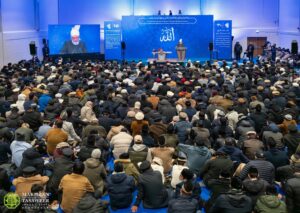
Towards the end of his address, Hazrat Mirza Masroor Ahmad recited a prayer that the Promised Messiah (peace be upon him) had written for his followers to recite.
The Promised Messiah (peace be upon him) states:
“O Lord of the worlds, I am unable to fully express gratitude for Your favours. You are exceedingly Merciful and Generous, and Your favours upon me are limitless. Forgive my sins lest I be destroyed. Place Your pure love within my heart so that I may attain true life. Conceal my faults and enable me to perform such deeds as may earn Your pleasure. I seek refuge in Your Noble Countenance from Your wrath descending upon me. Have mercy upon me and safeguard me from the afflictions of this world and the Hereafter, for every grace and bounty lies in Your hands alone.”
Hazrat Mirza Masroor Ahmad stated:
“Thus, these prayers were offered in order to teach us, and he exhorted us to supplicate in this manner. Pray in this way and establish a relationship with Allah the Almighty; pray for it, and Allah the Almighty will continue to strengthen this bond.
Therefore, if we act upon these matters, then God willing, we shall attain the objectives for which the Promised Messiah (peace be upon him) was sent, and for which we pledged allegiance to him. If we wish to become inheritors of the prayers of the Promised Messiah (peace be upon him), and especially of those prayers he offered for those who attend the Jalsa, then we must always keep these matters before us.”
His Holiness then instructed the members of the Community that they should constantly read and reflect upon the words of the conditions of bai‘at and have the words displayed in their homes.
Hazrat Mirza Masroor Ahmad said:
“In order to understand and repeatedly remind ourselves of the pledge of allegiance, we should keep it before us at all times, or place it somewhere where our eyes fall upon it repeatedly. People display many things in frames; if this too is framed and displayed, it will only be beneficial.”
At the end of his address, Hazrat Mirza Masroor Ahmad prayed with the following words:
“May Allah grant that every one of us brings about pure transformations within our condition and remains engaged in striving to fulfil the conditions of bai‘at. In this regard, the Promised Messiah (peace be upon him) offered countless admonitions with deep anguish. If we wish to become inheritors of his admonitions and of the prayers he offered for us, then we must change our actions and bring about a clear and evident transformation within ourselves. Only then will we attain the objective which is the very purpose of our bai‘at. May Allah the Almighty grant us the ability to do so. Ameen.”