Youth from USA South-West Region Have Honour of A Meeting with Head of the Ahmadiyya Muslim Community
“Strive to regulate your life around the prayer timings and you will naturally become disciplined.” – Hazrat Mirza Masroor Ahmad
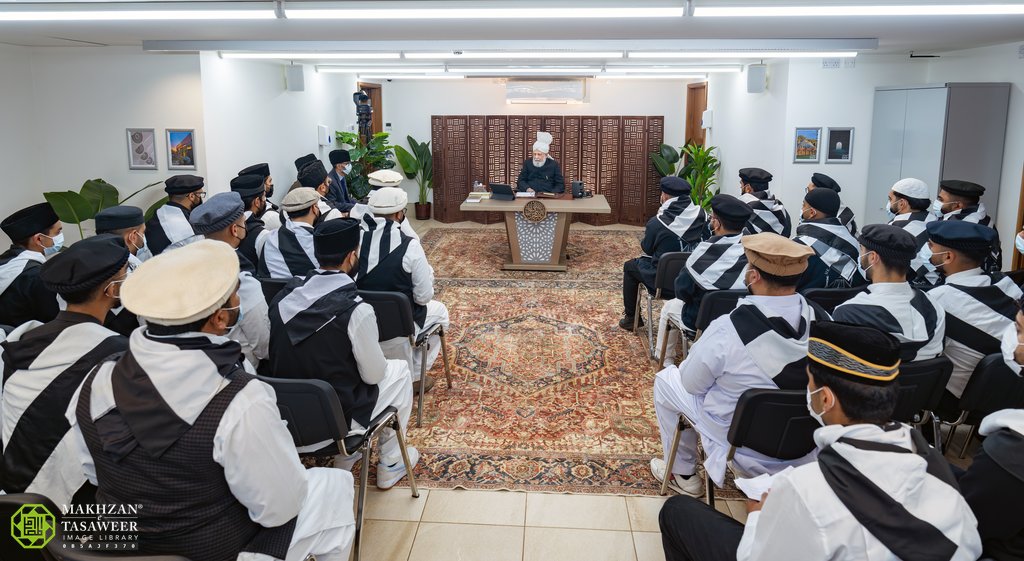
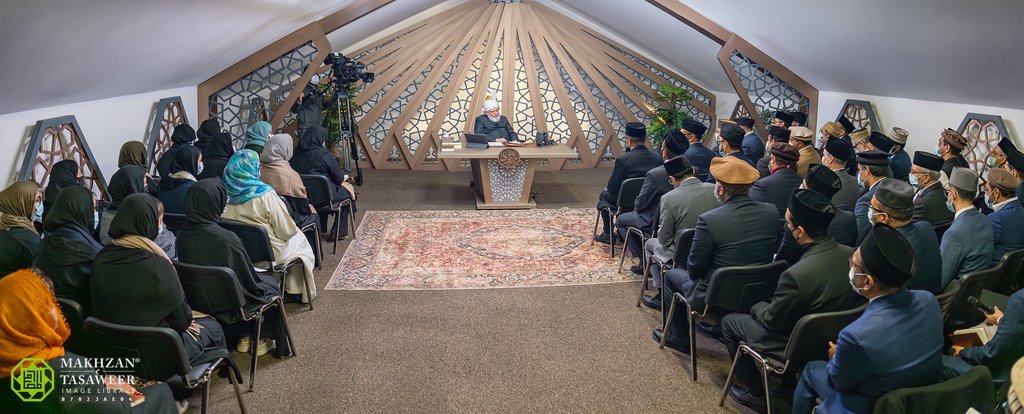
On 1 November 2025, the World Head of the Ahmadiyya Muslim Community, the Fifth Khalifa (Caliph), His Holiness, Hazrat Mirza Masroor Ahmad held a meeting with a delegation of members of Majlis Khuddam-ul-Ahmadiyya (Ahmadiyya Muslim Youth Association) from USA’s South-West Region.
His Holiness presided the meeting from MTA Studios in Islamabad, Tilford.
Upon arriving at the studio, His Holiness warmly greeted the delegation. Each member then introduced themselves, sharing their family background, roles within the Ahmadiyya Muslim Community, and current professional or academic pursuits. During the meeting, attendees also had the opportunity to seek the guidance and counsel of His Holiness on various matters.
One attendee highlighted the challenges of greed and inequality in the world and asked His Holiness what practical steps the Ahmadiyya Muslim Community and individuals could take to create a society that prioritises humanity.
Hazrat Mirza Masroor Ahmad stated:
“The Qur’an teaches us that we should help the needy people, that there should be justice in the world and that we should treat every human being on equally. This is the teaching of the Qur’an and so you should aim not only to practice it but to preach and spread this message to other people as well. The Qur’an says that you should take care of the orphans, needy people, the poor – give charity to those people and help them to stand on their own feet. These are the practical steps you can take, and the Ahmadiyya Muslim Community is working on it. The department of Khidmat-e-Khalq (Service to Mankind) and Humanity First are working on it. We are not only helping through Humanity First in areas where there is a disaster but also there are some regular projects as well run by Humanity First. For example, hospitals, schools, villages and water pumps.”
His Holiness continued, drawing attention to the Qur’an’s call for justice and compassion within society. He said that Islam teaches believers to view the poor as their brothers and to strive for “absolute justice,” so that no one is left behind. His Holiness noted that even though governments provide assistance to those in need, it remains the moral responsibility of Muslims – and especially members of the Ahmadiyya Muslim Community – to ensure that vulnerable people are cared for and supported through personal effort and service.
Another attendee inquired how Ahmadis should approach the study of philosophy in a way that benefits from its insights while remaining spiritually protected.
Hazrat Mirza Masroor Ahmad said:
“The Promised Messiah (peace be upon him) has very clearly elaborated on this subject in his book, ‘the Philosophy of the Teachings of Islam’. The book contains numerous chapters, including ‘What is the Purpose of Life?’, ‘What is the Purpose of Religion?’, ‘Life After Death’, and ‘What Are the Duties of Human Beings Towards Their Creator and Their Fellow Beings?’. It addresses a wide range of important topics.”
Hazrat Mirza Masroor Ahmad further said:
“The laws and teachings of the secular world are not perfect. It is only Allah whose commandments and teachings are perfect – that is what we believe. You will often see that they change their point of view, with new theories that are coming out. They do not stick to one thing, whereas the Qur’an was revealed to the Holy Prophet (peace and blessings of Allah be upon him) 1,400 years ago, and it remains intact in its original form. The Qur’an says that all the problems that human beings may face have been elaborated upon and explained therein.”
Expanding on the guidance, His Holiness referenced a couplet of Hazrat Mirza Bashiruddin Mahmood Ahmad, the second Caliph of the Ahmadiyya Muslim Community (may Allah be pleased with him), who said: ‘Do not at all make intellect rule over religion, it is blind in itself if there is no light of revelation’. His Holiness explained that those who focus solely on worldly matters are limited in understanding, and that true wisdom can only be developed through a strong relationship with Allah the Almighty and by seeking His guidance. He emphasised that believers should not be overly concerned with the opinions of the secular world but instead recognise the wisdom and perfection of Islamic teachings, which are supported by numerous verses of the Qur’an. His Holiness noted that when properly understood, there is no conflict between science and worldly knowledge, or between morality and secular laws.
His Holiness further explained that while worldly laws may be amended after recognising mistakes, the Qur’an, as the final law-bearing book, requires no amendments and provides guidance for both religious and everyday worldly affairs. His Holiness encouraged attendees to read the Holy Qur’an with commentary to enhance their knowledge, guiding them to both the short and long commentaries published by the Ahmadiyya Muslim Community to deepen their understanding.
Turning to matters of personal devotion, an attendee asked His Holiness how he might deepen his focus, humility, and emotional connection in prayer.
Hazrat Mirza Masroor Ahmad stated:
“When you offer your prayers, recite the verse, ‘Guide us to the right path,’ repeatedly so that Allah the Almighty enables you to follow the right path, as well as the verse, ‘Thee alone do we worship and Thee alone do we implore for help.’ Keep repeating Surah Al-Fatiha (the first chapter of the Holy Qur’an) in your prayers to increase your focus. By reciting it repeatedly, you will better understand its meaning, particularly the benevolence of Allah the Almighty. Furthermore, if you reflect on the countless blessings and favours that God has bestowed upon you, you will feel grateful to Him. Just as you express thanks to someone who gives you a gift or does you a favour, in the same way you should express gratitude to Allah, which will naturally elevate your emotions during prayer.”
Following this, an attendee remarked that many parents today allow their children access to phones and the internet from a very young age simply to to avoid dealing with them and asked His Holiness how parents can instead focus on the proper moral training of their children.
Hazrat Mirza Masroor Ahmad stated:
“If parents give young children access to mobile phones, then that is wrong. However, if they insist to do so, they should make it clear that their children’s daily screen time must not exceed one hour. The harmful effects of such usage are now becoming apparent, which is why Australia has passed a bill stating that children under the age of 15 will not be to use social media. Although some people have raised objections, the government has responded that these devices are harming children – affecting their intelligence, as well as their morality and ethical standards. Parents should not ruin their children’s lives by shirking their responsibilities. Nowadays, even in schools, teachers assign homework on iPads, which some children misuse. However, certain schools have blocked particular websites and applications, allowing only educational tools and platforms linked to the school, such as homework-related apps. Therefore, parents must monitor their children very carefully.”
Another attendee asked His Holiness how one can develop true discipline in daily work and overcome laziness, referring to the personal example set by His Holiness.
Hazrat Mirza Masroor Ahmad stated:
“Allah the Almighty has, first and foremost, taught Muslims the principle of discipline through the commandment to offer the five daily prayers. When a person observes all five prayers – waking up early for Fajr, and then offering Dhuhr, Asr, Maghrib, and Ishaa’ – the prayer timings themselves naturally instil discipline in one’s life. Therefore, one should first try to develop this habit. After offering your prayers, when you have some time, you should engage in exercise and attend to your daily tasks. Try to sleep early at night, no later than midnight, especially as the nights are longer these days, allowing for sufficient rest. Strive to regulate your life around the prayer timings and you will naturally become disciplined. Since childhood, we have heard the saying, ‘early to bed and early to rise makes a man healthy, wealthy and wise,’ and indeed, this captures the essence of discipline.”
Towards the end of the session, an attendee, drawing attention to the humanitarian suffering in Gaza asked His Holiness how Ahmadi Muslims around the world can work to support the afflicted and foster peace.
Hazrat Mirza Masroor Ahmad stated:
“The fact is that the situation is very difficult, and we are not a government and do not have a military. However, we do have institutions through which we can serve humanity. Through our charity work, through Humanity First, we try to provide aid. Our volunteers, many of whom are Ahmadis and Palestinians, are working there with great dedication and sacrifice. This is what we can do. If other NGOs also require assistance, we try to support them as well… As far as conveying a message is concerned, our community members there are doing their part to the extent they can. Beyond that, the most important action is prayer. Pray for them. The Arab nations themselves are involved in this, so we must continue to pray. I recently mentioned that a UN report revealed that more than 60 countries have been complicit in the injustices inflicted upon the Palestinian people. This includes not only Europe and America, but also Arab nations, which could have pressured Israel to avoid attacks on Palestine. Even neighbouring Muslims are complicit. So, what can we do? We can only pray.”